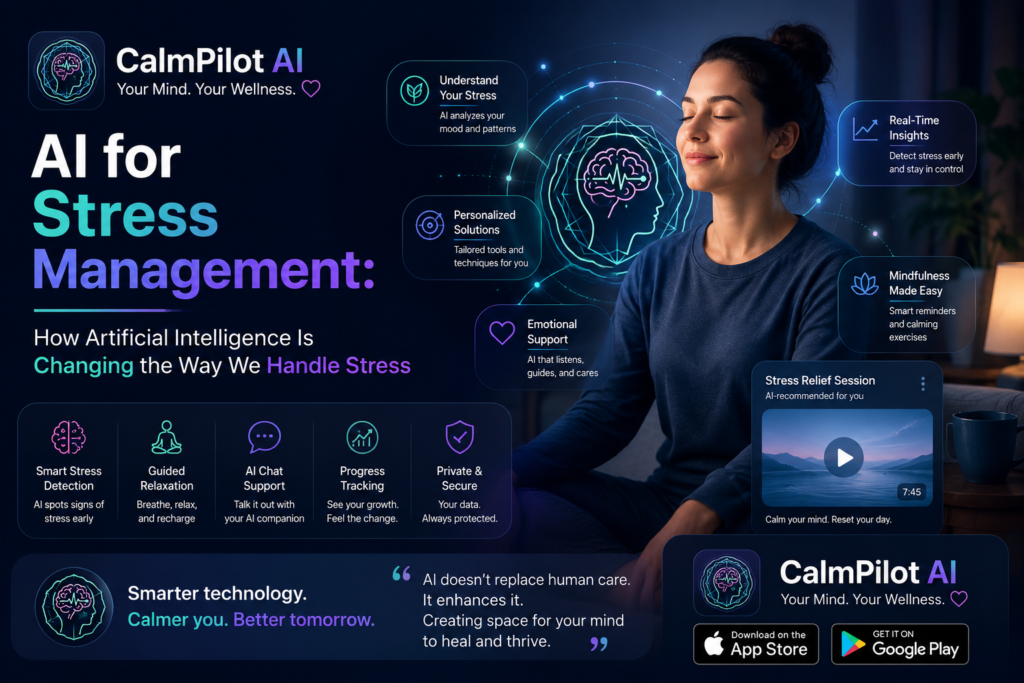
Stress is one of the most universal human experiences — and one of the most underserved by traditional mental health systems. Therapy waitlists stretch for months. Most people won’t reach out until they’re already in crisis. And the day-to-day accumulation of stress — the kind that builds quietly over weeks before it becomes a problem — rarely makes it into anyone’s appointment book.
Artificial intelligence isn’t a replacement for professional mental health care. But it’s doing something that traditional care has always struggled with: being available at the right moment, noticing patterns over time, and lowering the barrier to engaging with your mental health before things get bad. Here’s what AI for stress management actually looks like in practice — and what the evidence says about whether it works.
What AI for Stress Management Actually Does — and What It Doesn’t
The most important thing to understand about AI in mental wellness is what it’s designed to do. It is not a diagnosis tool. It’s not a replacement for a therapist. What it does well is fill the large gap between “fine” and “needs clinical help” — the territory where most stress lives, and where most people currently have no support at all.
In practical terms, AI for stress management works across four areas:
- Pattern recognition — identifying trends in your mood, energy, sleep, and behaviour that you’re too close to see yourself
- Immediate accessibility — being available at 2am, mid-anxiety, on a Tuesday — without a booking, a waiting room, or a judgement
- Guided techniques — walking you through breathing exercises, grounding techniques, and cognitive reframes in the moment you need them
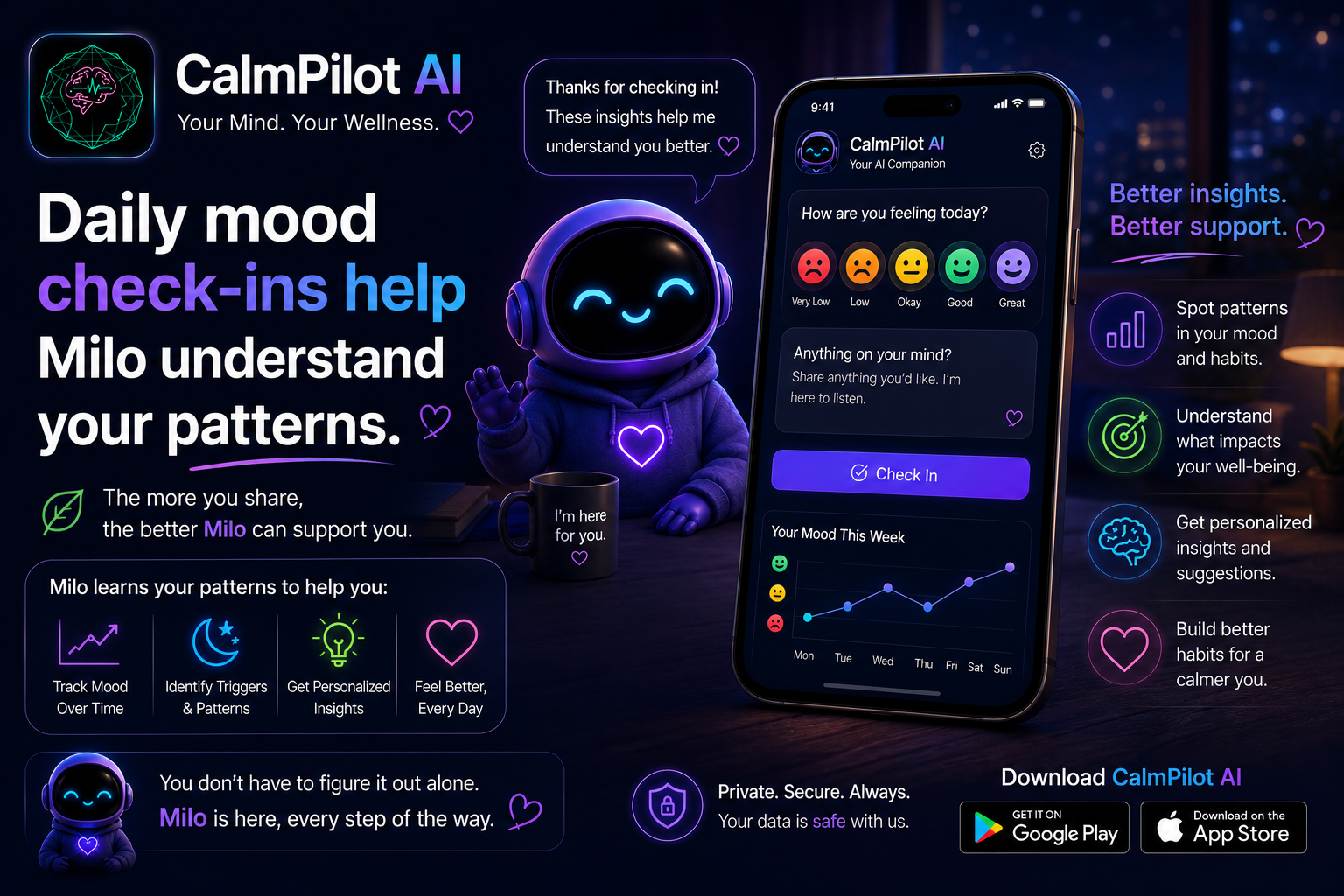
- Consistent check-ins — maintaining a daily pulse on your mental state so changes are caught early, not retrospectively
These aren’t small things. The gap between knowing you’re stressed and actually doing something about it is where most people get stuck — and AI addresses that gap more practically than anything else currently available at scale.
How AI Mood Tracking Spots Stress Patterns Before You Do
Human beings are notoriously bad at perceiving gradual change in themselves. You don’t notice your sleep getting worse night by night. You don’t track that your irritability has been higher every Monday for three weeks. You don’t connect that the weeks you skip lunch breaks are the same weeks you feel overwhelmed by Friday.
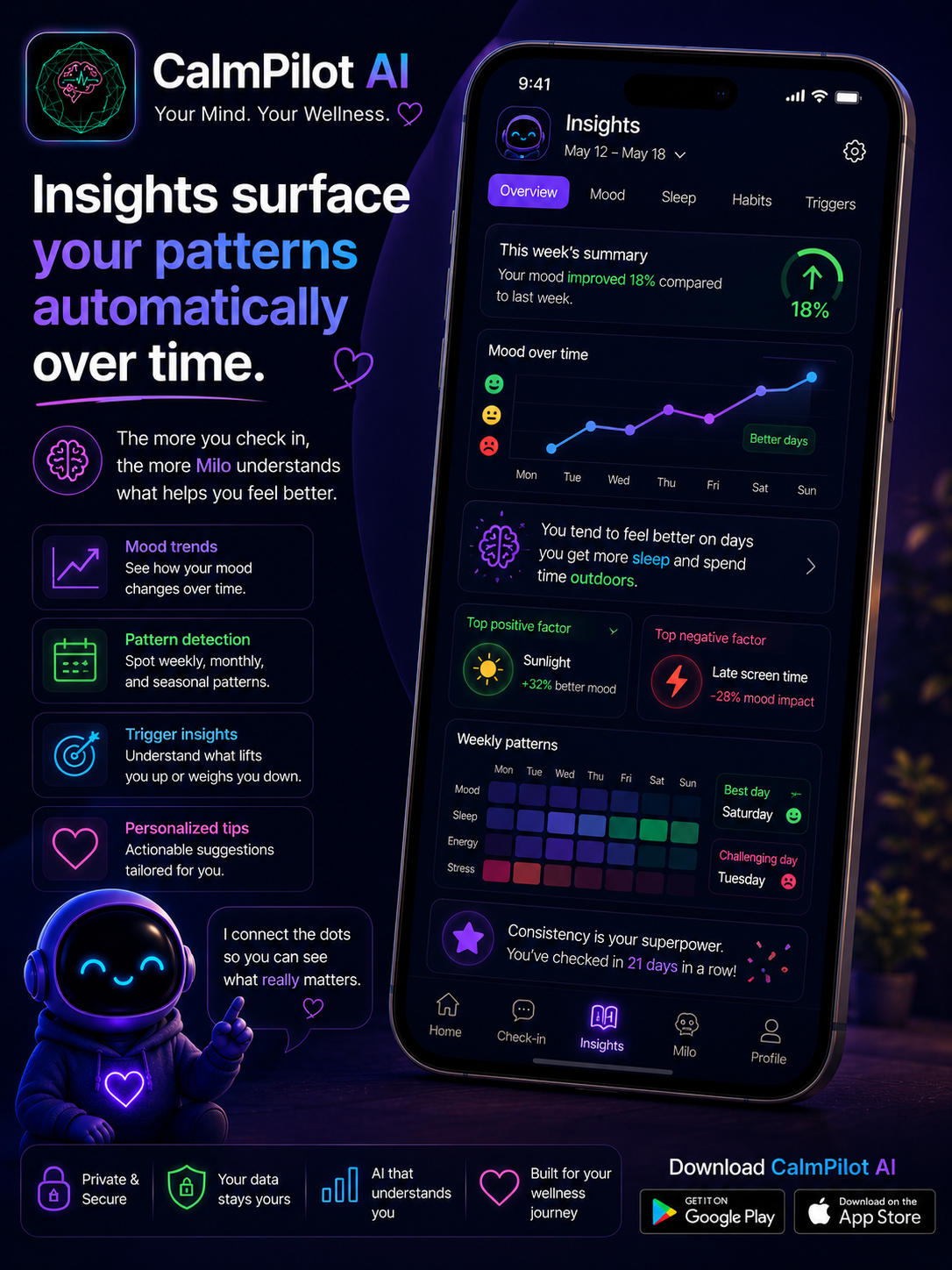
AI mood tracking does all of this passively. By logging small data points consistently — mood, energy, stress level, sleep quality, notes about the day — it builds a longitudinal picture that no human could hold in their head. Over time, the patterns become visible: the triggers, the conditions that worsen stress, the things that reliably help.
This kind of pattern visibility changes how you respond to stress. Instead of reacting to symptoms when they’re already severe, you start recognising precursors — the early warning signals that stress is building — and intervening earlier, when the tools are more effective and the effort required is less.
The most effective stress management isn’t the technique you use during a crisis — it’s the awareness that lets you catch the crisis before it forms.
AI Companions for Stress: The Case for Having Somewhere to Put It
One of the most consistent findings in stress research is that social support — having someone to talk to — is among the most powerful buffers against stress and its health consequences. People with strong social support systems have lower cortisol responses, recover faster from stressful events, and report significantly better wellbeing.
But most adults lack adequate social support for mental health conversations. They don’t want to burden friends and family. They’re afraid of being seen as struggling. They don’t have the kind of relationship where this kind of honesty feels safe. And so the stress stays internal — circling, accumulating, unprocessed.
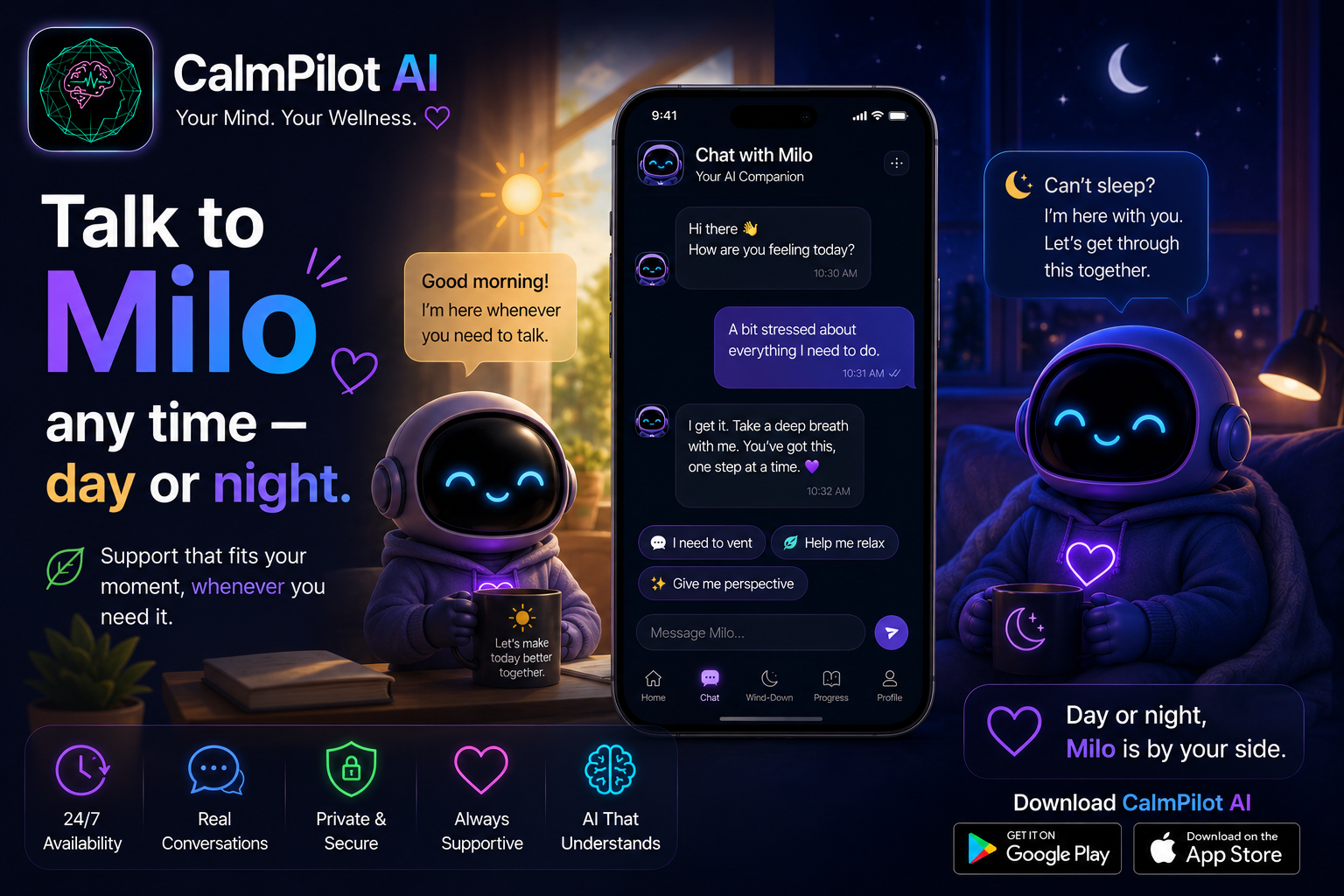
AI companions like Milo don’t replace human connection. What they provide is a place to externalise what’s building — to say the thing you can’t say to the people in your life, to process the day’s emotional residue without needing it to be convenient for someone else. Research on expressive disclosure shows that the act of articulating stress — putting it into words — reliably reduces its emotional intensity, regardless of whether a human receives those words.
Availability is the underrated part. Stress doesn’t respect business hours. A 2am anxiety spiral doesn’t wait until your therapist is available on Thursday. Having something accessible in that moment — something that doesn’t judge, doesn’t tire, doesn’t make you feel like a burden — is a genuine mental health resource, not a gimmick.
AI-Guided Breathing and Calming Techniques That Work in the Moment
Knowing that box breathing reduces anxiety is useless if you can’t remember the steps when you’re in the middle of a stress response. This is where guided AI tools provide genuine value: they bridge the gap between knowledge and application at the exact moment the technique is needed.
The most effective AI wellness tools don’t just provide information — they guide you through evidence-based stress techniques in real time, adapting to your current state. Sensing that your logged mood is low, or that you’ve noted high stress, the best tools surface the right technique at the right moment: a breathing exercise, a grounding prompt, a quick calming activity.
Consistency matters enormously here. Research on stress management techniques consistently shows that the benefit is cumulative — people who use breathing and mindfulness techniques daily build a stronger baseline resilience than those who use them only during crises. AI tools make daily practice frictionless: a 30-second check-in, a 5-minute guided exercise, a brief mood log. The bar is low enough that it actually happens.
Calming Games as an AI Stress Management Tool — The Neuroscience
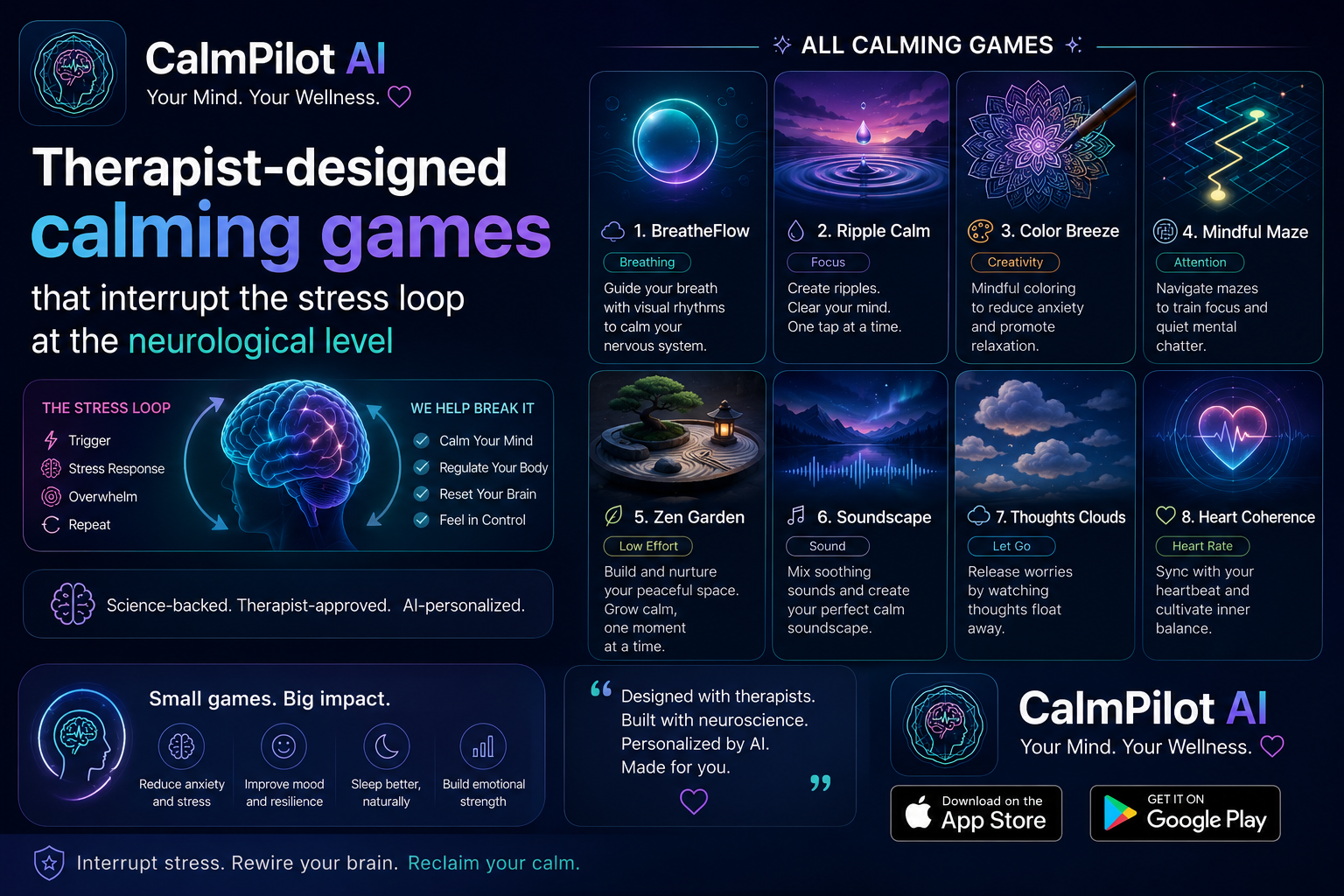
One of the more unexpected findings in digital mental health research is how effective well-designed calming games are for acute stress reduction. The mechanism connects directly to how anxiety works in the brain.
Anxiety is driven largely by the default mode network — the brain’s resting-state circuit that, in stressed individuals, defaults to threat scanning, rumination, and worry loops. Engaging in a focused task — particularly a spatial, visual, or pattern-matching task — activates the dorsal attention network, which directly competes with and suppresses the default mode.
In other words: it’s neurologically very difficult to ruminate while actively solving a calm pattern puzzle. The focused attention displaces the worry. This is different from passive scrolling, which keeps the brain occupied without actually resting it — and different from entertainment, which can raise arousal. Calming games occupy cognitive bandwidth with something genuinely benign, quiet the threat-scanning system, and produce a state of absorbed, low-arousal focus that breaks the stress loop.
What the Research Says About AI Mental Health Tools
The evidence base for digital mental health tools has grown significantly in the past five years. Key findings:
- A 2023 meta-analysis in JMIR Mental Health found that smartphone-based mental health interventions produced significant reductions in anxiety and depression symptoms across 66 randomised controlled trials.
- Studies on AI chatbot interventions (including Woebot, one of the most researched) show reductions in anxiety and depression symptoms comparable to brief CBT-based interventions — particularly for mild-to-moderate presentations.
- Research on mood tracking apps consistently shows that consistent use correlates with increased self-awareness, earlier identification of deteriorating mental health, and greater engagement with other help-seeking behaviours.
- A 2022 study in Frontiers in Psychiatry found that daily micro-interventions (brief mood logs, short guided exercises, 5-minute calming activities) produced meaningful mental health improvements when maintained consistently over 4–8 weeks.
The evidence doesn’t suggest AI replaces therapy — it suggests AI fills a real gap, particularly for the large proportion of people whose stress and anxiety don’t meet the threshold for clinical care but are nonetheless significantly affecting their quality of life.
The Limits of AI for Stress Management — What It Can’t Do
Honest coverage of AI in mental health requires acknowledging the limits. AI tools are not appropriate as a primary intervention for:
- Clinical depression, anxiety disorders, or other diagnosed mental health conditions requiring professional treatment
- Trauma processing, which requires a trained therapist working in a proper therapeutic framework
- Crisis situations — anyone experiencing suicidal ideation or acute mental health emergencies should contact a crisis line or emergency services, not an AI app
- Complex interpersonal or situational problems that require professional human judgement
Used appropriately — as a daily stress management tool, an early-warning system, a place to process low-to-moderate emotional load — AI adds genuine value. Used as a substitute for care that someone actually needs, it delays help. The distinction matters.
AI for Stress Management: A Tool for the Gap That Traditional Care Doesn’t Reach
The mental health system was built for crises. It does not scale to the daily stress management needs of hundreds of millions of people who are not in crisis but are not okay either. AI doesn’t fix the system — but it serves the gap the system leaves.
Daily mood awareness. Pattern visibility. Accessible emotional support at any hour. Guided techniques delivered in the moment. Calming games that interrupt the stress loop when your mind won’t let you rest. These aren’t replacements for human care — they’re the layer of consistent, daily, low-friction support that human care has never been able to provide at scale.
The goal isn’t to outsource your mental health to an algorithm. It’s to have one more reliable tool in the day — something that shows up every day, notices the patterns, and meets you where you are before the load becomes a crisis.