
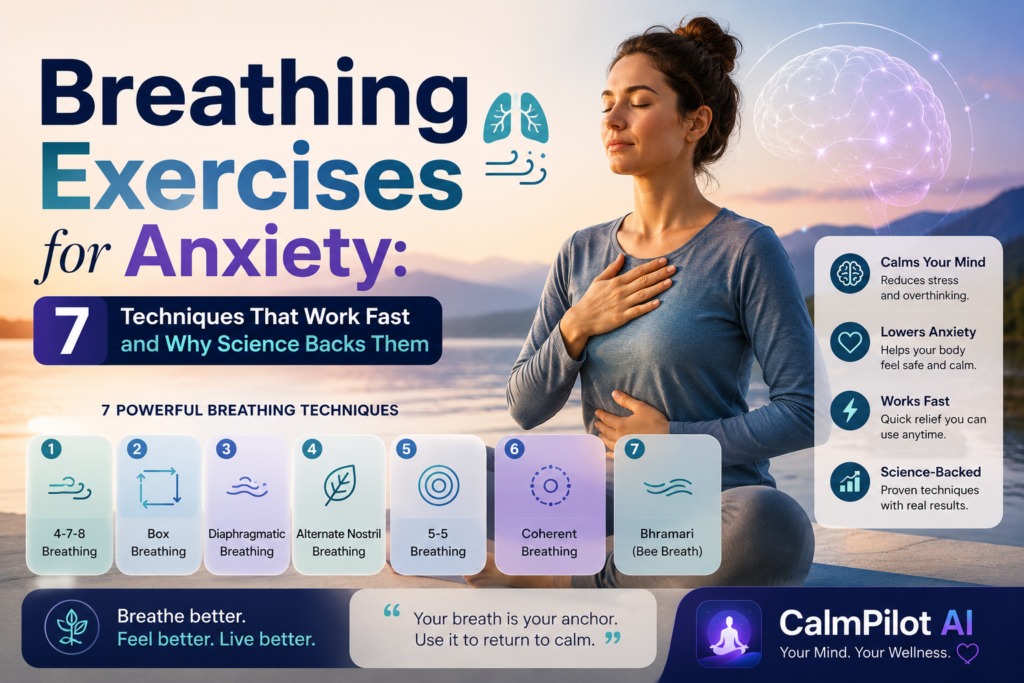
When anxiety hits, your body activates the stress response: heart rate spikes, muscles tighten, breathing becomes shallow and fast, and the prefrontal cortex — the part of your brain responsible for rational thought — starts going offline. It happens automatically, without your permission, in seconds.
But here’s what most people don’t know: breathing is the only part of that response you can consciously override. It’s the one bidirectional channel between your autonomic nervous system and your voluntary control. Change how you breathe, and you directly change the physiological state driving the anxiety — not metaphorically, but mechanically.
These seven breathing techniques are evidence-backed, require no equipment, and work in minutes. Some are best for acute anxiety — the sudden spike, the panic moment. Others work best as a daily practice that lowers your baseline anxiety over time. All of them are worth having.
Why Breathing Exercises for Anxiety Actually Work
The mechanism is the vagus nerve — the longest cranial nerve in the body, running from your brainstem down through your heart, lungs, and gut. It’s the primary pathway of the parasympathetic nervous system, responsible for the rest-and-digest state that is the opposite of anxiety’s fight-or-flight.
Slow, extended exhalation stimulates the vagus nerve. This triggers a cascade: heart rate variability increases, cortisol drops, the amygdala (your brain’s threat detector) becomes less reactive, and the prefrontal cortex comes back online. The effect is measurable within two to three minutes — and for some techniques, within seconds.
The key variable across all effective breathing techniques is the same: exhale longer than you inhale. The inhale activates the sympathetic nervous system slightly; the exhale activates the parasympathetic. The ratio determines which system wins.
1. Box Breathing — The Special Forces Reset
Box breathing (also called square breathing or tactical breathing) is used by Navy SEALs, surgeons, and first responders to reset the nervous system under acute stress. It’s the gold standard for immediate anxiety relief because it’s simple, reliable, and fast.
How to do it:
- Inhale slowly through your nose for 4 counts
- Hold for 4 counts
- Exhale slowly through your mouth for 4 counts
- Hold for 4 counts
- Repeat for 4–6 cycles
The equal-ratio pattern interrupts the shallow, irregular breathing pattern of anxiety and forces a shift to slow, deliberate rhythm. Most people notice a measurable drop in heart rate and physical tension within three minutes. Use it before a stressful conversation, during a panic moment, or before sleep when your mind won’t stop.
2. The 4-7-8 Technique — Deep Nervous System Reset
Developed and popularised by Dr. Andrew Weil, the 4-7-8 technique extends the exhale significantly — activating the parasympathetic response more strongly than box breathing. It’s particularly effective for anxiety that has been building for hours, not just minutes.
How to do it:
- Exhale completely through your mouth
- Close your mouth and inhale through your nose for 4 counts
- Hold your breath for 7 counts
- Exhale completely through your mouth for 8 counts
- Repeat 3–4 cycles
The 8-count exhale is the key: it’s twice the length of the inhale, producing a strong vagal activation. Some people feel slightly lightheaded after the first cycle — this is normal and passes. Don’t do more than 4 cycles in a sitting until you’re comfortable with the technique.
You can’t simultaneously breathe slowly and feel acute panic. The physiological states are incompatible — which is why breathing is the fastest tool available for anxiety relief.
3. Diaphragmatic Breathing — Retrain Your Default Pattern
Most anxious people breathe thoracically — in the chest, shallow, and fast. This pattern signals low-grade danger to the nervous system even when none exists, maintaining baseline anxiety through the day. Diaphragmatic breathing (belly breathing) is the physiologically correct resting pattern and can, with practice, become your default.
How to do it:
- Place one hand on your chest and one on your belly
- Breathe in slowly through your nose — your belly should rise while your chest stays relatively still
- Exhale slowly — your belly falls
- Aim for 6–8 breaths per minute (about 5 seconds in, 5 seconds out)
Research shows that consistent diaphragmatic breathing practice — 10 minutes daily for 4–6 weeks — reduces baseline cortisol, lowers resting heart rate, and measurably reduces self-reported anxiety scores. It’s a long-game technique: not as dramatic as box breathing in the moment, but it changes your resting state over time.
4. The Physiological Sigh — The Fastest Anxiety Reset Known
The physiological sigh is a double inhale through the nose followed by a long exhale. It’s something your body does spontaneously every few minutes during normal breathing — often misread as frustration or sadness — because it’s the most efficient way to deflate the air sacs in your lungs that collapse under stress and restrict oxygen exchange.
Stanford neuroscientist Dr. Andrew Huberman has highlighted this as the fastest way to reduce acute physiological arousal — faster than any other known breathing pattern.
How to do it:
- Take a full inhale through your nose
- At the top of the inhale, take a second quick sniff through your nose — a top-up breath
- Exhale fully and slowly through your mouth until your lungs feel empty
- Repeat 1–3 times
The double inhale maximally inflates the lungs and re-opens collapsed air sacs. The long exhale then expels a large volume of CO2 — and it’s rising CO2, not falling oxygen, that drives the sensation of panic. Within one or two cycles, most people notice a sharp drop in physiological tension. This is the one to use in the acute moment.
5. Resonance Breathing — The Daily Anxiety Prevention Practice
Resonance breathing (also called coherent breathing) is breathing at exactly 5–6 breaths per minute — roughly 5 seconds in, 5 seconds out. At this rate, your heart rate and breathing rhythms synchronise in a state called heart rate variability (HRV) coherence, which produces maximum vagal tone.
Research published in Applied Psychophysiology and Biofeedback shows that 20 minutes of resonance breathing daily — consistently over 4–8 weeks — produces durable reductions in anxiety, depression, and physiological stress markers. Unlike acute techniques, this is a training approach: you’re not trying to feel better in the moment, you’re raising your baseline resilience.
Use an app timer or simply count: 5 seconds in, 5 seconds out. Do it during a commute, at a desk, or before sleep. There’s no wrong context — just consistency.
6. Alternate Nostril Breathing — For Mental Calm and Focus
Nadi shodhana (alternate nostril breathing) comes from yoga tradition but has measurable physiological effects documented in modern research. Studies show it reduces anxiety, lowers blood pressure, and improves both hemispheric coordination in the brain and oxygen efficiency in the lungs.
How to do it:
- Using your right hand, place your thumb over your right nostril and your ring finger over your left
- Close the right nostril with your thumb — inhale through the left for 4 counts
- Close both nostrils and hold for 4 counts
- Release the right nostril — exhale through the right for 4 counts
- Inhale through the right for 4 counts
- Close both — hold for 4 counts
- Exhale through the left for 4 counts. That’s one cycle.
- Repeat for 5–10 cycles
It sounds complex but becomes automatic quickly. The focused attention it requires also gives the mind something specific to do — preventing the rumination that typically accompanies anxiety.
7. Extended Exhale Breathing — Simple, Portable, Always Available
If you remember nothing else from this article, remember this: make your exhale longer than your inhale. Any ratio that achieves this produces a parasympathetic response. The exact numbers are less important than the principle.
A simple version: inhale for 4 counts, exhale for 6 or 8. No holding required. No specific hand position. No counting of cycles. Just breathe in, and breathe out longer than you breathed in. Repeat until you feel the shift.
This is the version that works in a meeting you can’t leave, on public transport, in a conversation that’s raising your anxiety. No one can see it. No one knows you’re doing it. And within two or three minutes, your nervous system starts to respond.
Which Breathing Exercise Should You Try First?
If you’re in acute anxiety or a panic moment — physiological sigh (fastest) or box breathing.
If you want a daily practice to lower baseline anxiety over weeks — resonance breathing or diaphragmatic breathing.
If you need calm focus before something demanding — 4-7-8 or alternate nostril.
If you’re in public and need something invisible — extended exhale breathing.
Start with one technique. Use it consistently for a week in low-stakes moments — before bed, during a commute — before trying it under real anxiety. The technique needs to be familiar before it works under pressure. You can’t learn to swim during a storm.
Your nervous system responds to what you practise most. A breathing habit you build in calm moments is the one that’s actually available when anxiety hits.