
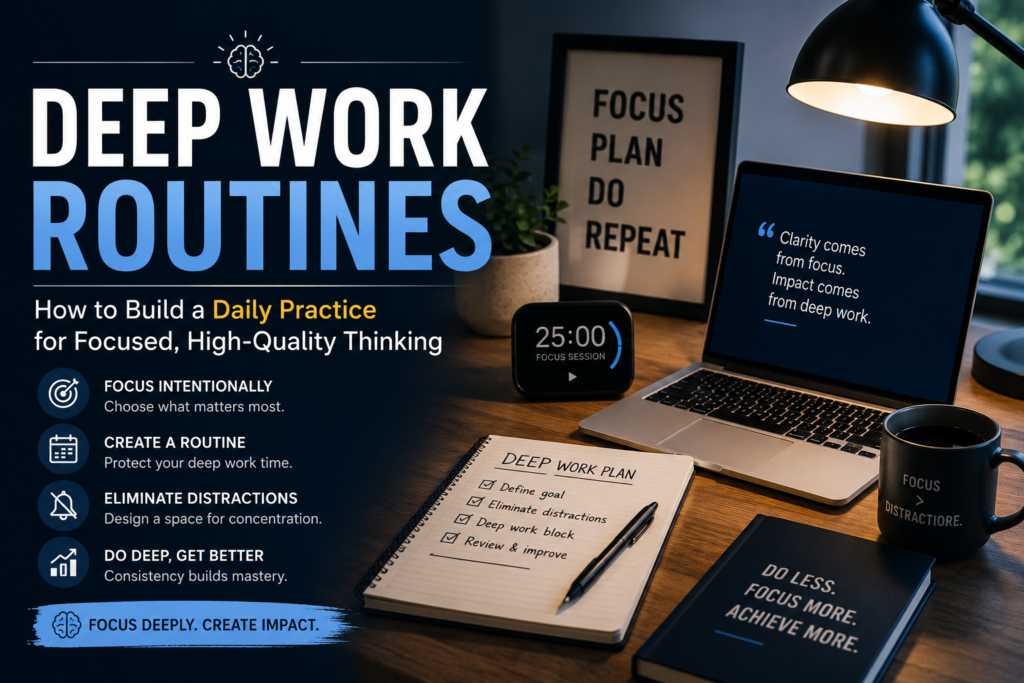
Cal Newport defines deep work as “professional activity performed in a state of distraction-free concentration that pushes your cognitive capabilities to their limit.” It’s the kind of thinking that produces work you’re genuinely proud of — the solved problem, the finished piece, the insight that changes direction. And it’s becoming increasingly rare.
The average knowledge worker now spends only about 4 minutes on a task before being interrupted. Their email inbox generates a response reflex within 6 seconds of a notification. Their days are full of activity — meetings, messages, shallow tasks — and largely empty of depth.
The ability to do deep work is not just a productivity skill. It’s a cognitive and emotional one. People who regularly engage in it report higher satisfaction, stronger sense of purpose, and lower baseline anxiety. The frustration of a fragmented, shallow day is not just about output — it’s about the quality of your inner experience while you work.
Here’s how to build a routine that makes deep work happen every day — not just when conditions are perfect.
1. Understand Why Deep Work Fails Without a Routine
Most people approach deep work reactively: they intend to do it, wait for a clear block of time to appear, and hope their willpower carries them through. This fails for three reasons.
- Decision fatigue: Every time you decide whether to check email or start deep work, you spend mental energy. By midday, you’re defaulting to easy tasks.
- Attention residue: Research by Sophie Leroy shows that when you switch between tasks, cognitive residue from the previous task persists and impairs performance on the next one. Frequent task-switching accumulates this residue throughout the day.
- No protected time: Without scheduled deep work blocks, shallow tasks expand to fill all available time — because they’re easier, more urgent-feeling, and constantly incoming.
A routine removes the decision, pre-commits your time, and creates the conditions deep work needs before you have to rely on willpower.
2. Choose Your Deep Work Philosophy
Newport identifies four approaches to scheduling deep work. Choosing the one that fits your life is the first structural decision — and getting it wrong explains why many people’s attempts fail.
- Monastic: Eliminate or radically minimise all shallow obligations. Best for academics, writers, and independent researchers. Not realistic for most people.
- Bimodal: Divide your time into deep and shallow seasons or weeks — deep work for several consecutive days, then back to normal. Works well for senior professionals who can control their calendar in chunks.
- Rhythmic: Schedule a fixed daily deep work block — same time, every day. The most practical approach for most people. Habit formation reduces the friction of starting.
- Journalistic: Fit deep work in wherever you can, switching into depth mode on short notice. Requires advanced skill at transitioning — not suited for beginners.
For most people starting out, the rhythmic philosophy is the most achievable. Pick a time, protect it, show up every day.
The single best predictor of whether someone does deep work consistently is not their motivation or talent — it’s whether they have a scheduled time for it that doesn’t require a daily decision.
3. Design Your Deep Work Block
A deep work block isn’t just a gap in your calendar. It has structure. Here’s what a well-designed block looks like:
Duration: Start with 60–90 minutes. Most people overestimate how long they can sustain deep focus — especially at first. Build up gradually. 4 hours of genuine depth is an exceptional day; 90 minutes is a solid, sustainable one.
Singular focus: Before the block starts, identify the one specific task for that session. Not “work on the project” — “write the first draft of section 2.” Vague intentions produce vague attention.
Pre-block ritual: A consistent 5-minute ritual signals to your brain that depth is beginning. Review your task, silence notifications, make tea, take three breaths. The ritual primes the neurological shift — after a few weeks, your brain begins entering focus mode at the start of the ritual automatically.
No escape hatches: Phone in another room. Browser tabs closed to everything except what you need. Door shut or headphones on. Remove the temptation before the session, not during it — mid-session resistance is much harder to win.

4. Protect Your Biological Peak Hours
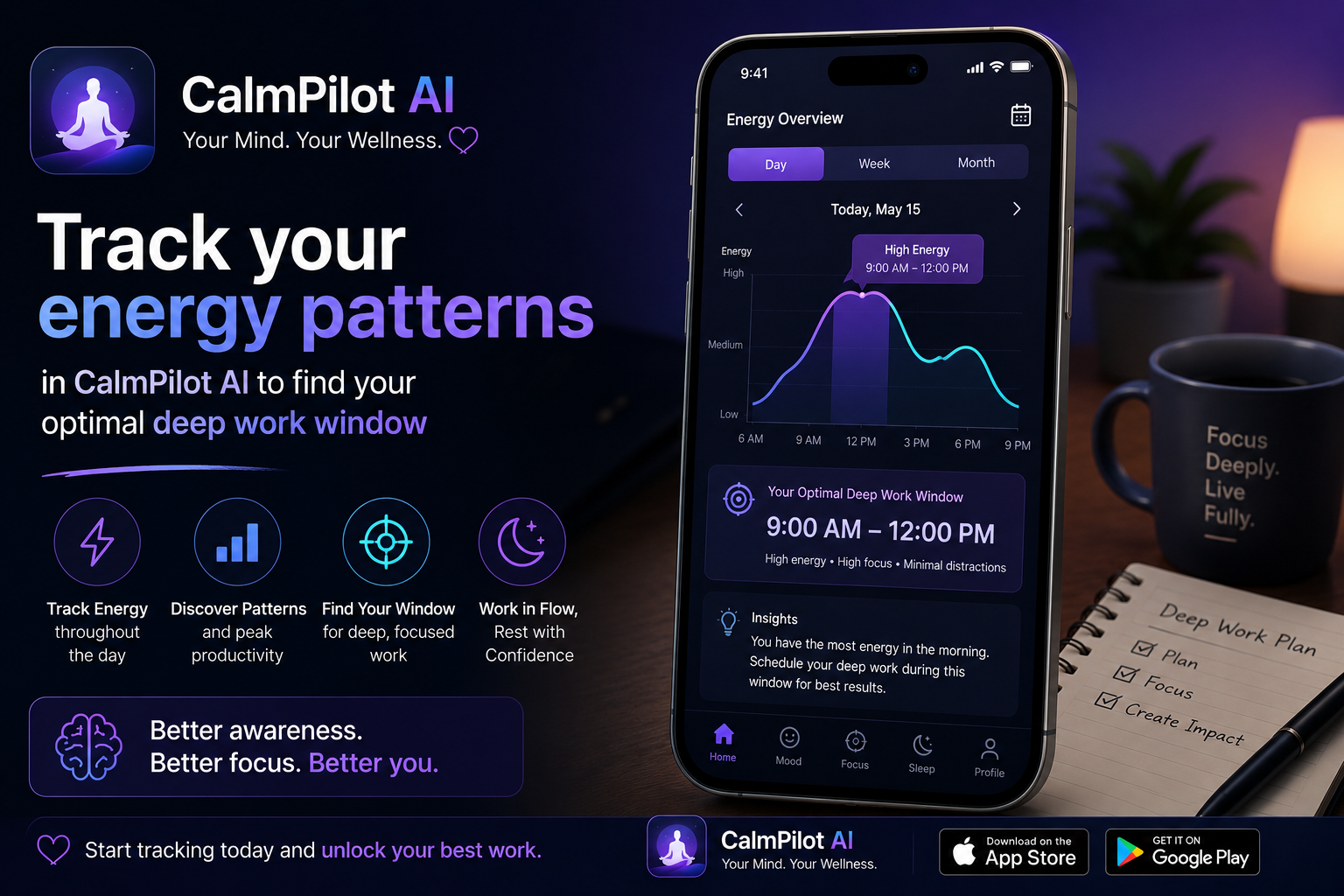
Your capacity for deep work is not evenly distributed across the day. Cognitive performance peaks at different times depending on your chronotype — morning larks tend to peak 2–4 hours after waking, while evening types peak in the late afternoon or evening.
Scheduling your deep work block during your biological peak — when alertness, working memory, and prefrontal cortex function are highest — produces significantly better results than doing it at an arbitrary time. And yet most people fill their best hours with email and meetings, saving the demanding work for when they’re already depleted.
To find your peak:
- Track your energy and focus levels at different times of day for one week
- Notice when thinking feels clearest, decisions feel easiest, and creative output flows most naturally
- Schedule deep work there — and schedule meetings, admin, and communication outside of it
5. Build a Shutdown Ritual That Actually Closes Work
Deep work requires genuine recovery. If your workday bleeds into evening through half-finished thinking and background email monitoring, your cognitive resources never fully replenish — and tomorrow’s deep work block starts from a depleted baseline.
A shutdown ritual creates a hard boundary between work and rest. It takes 10 minutes and follows a fixed sequence:
- Review every open task and ensure it’s captured somewhere trusted
- Check tomorrow’s calendar and identify the deep work task for the morning block
- Write a single sentence closing the day: “Shutdown complete.”
- Close all work applications
Newport describes this as “shutdown complete” — a verbal declaration that trains the brain to stop background-processing work. It sounds small. The effect is not.
6. Manage Attention — Not Just Time
Time management is necessary but insufficient for deep work. You can clear three hours on your calendar and still produce nothing if your attention is fragmented. Attention management — deliberately directing and protecting your focus — is the actual skill.
Practices that strengthen attention management:
- Productive meditation: During a walk or commute, hold a single professional problem in your mind and work through it deliberately. No phone, no podcast. This trains the skill of sustained directed attention in a low-stakes environment.
- Attention training games: Pattern recognition and spatial tasks — the kind that require sustained focus without anxiety — build the attentional muscles that deep work depends on. 10 minutes daily produces measurable improvements within weeks.
- Boredom tolerance: Deliberately resist reaching for your phone during idle moments — waiting in a queue, sitting in a lift. Every time you override the impulse, you strengthen the attentional control that deep work requires.


7. Address the Emotional Resistance to Deep Work
Here’s what most deep work advice doesn’t say: starting a deep work session is uncomfortable. The moment you sit down to do genuinely demanding cognitive work, your brain generates resistance — an urge to check something, do an easier task first, or “just quickly” deal with that email.
This resistance is not laziness. It’s the brain’s natural preference for certainty and immediate feedback over effortful, uncertain cognitive work. The discomfort of not knowing whether you’re making progress, of sitting with difficulty without a quick resolution, is genuinely aversive.
Recognising this changes your relationship to it. The resistance isn’t a signal that something is wrong — it’s a signal that you’re doing exactly the right kind of work. Sitting with that discomfort for the first 10–15 minutes, without acting on it, is the actual practice. It almost always passes.
Managing your emotional state around work — tracking mood, identifying what depletes vs energises you, processing anxiety before it hijacks your focus — is what separates people who do deep work occasionally from those who do it consistently.
8. Start Small and Protect What You Build
The most common mistake people make with deep work routines is trying to do too much too soon. They schedule 3-hour blocks before they’ve built the focus capacity to sustain 45 minutes. They attempt five deep work days a week before they’ve managed three.
Build like a physical training programme:
- Week 1–2: One 60-minute deep work block per day, same time
- Week 3–4: Extend to 90 minutes, or add a second shorter block
- Month 2+: Build toward 2–4 hours of total daily depth, split across blocks
And protect what you build. Say no to meetings in your deep work window. Don’t check email first thing. Treat the block as non-negotiable — because it is. Shallow work will always feel urgent. Deep work is important but rarely urgent, which means it gets sacrificed unless you actively defend it.
The Work That Matters Most Requires the Most Protection
Deep work is where your best thinking happens. It’s where problems get solved, work gets finished, and ideas become real. It’s also the first thing to disappear when life gets busy — which is exactly when you need it most.
A routine doesn’t make deep work easy. It makes it inevitable. Same time, same ritual, same commitment — until it’s not a discipline you maintain but a practice you inhabit.
Start with one block tomorrow. Protect it like it’s the most important meeting of your day. It is.