If you walked into a cognitive neuroscience lab today — at Harvard, at University College London, or at the Max Planck Institute — you would likely find researchers using the same three core tests they have used for decades. Not because science has failed to invent better tools, but because these three happen to be extraordinarily good at what they do.
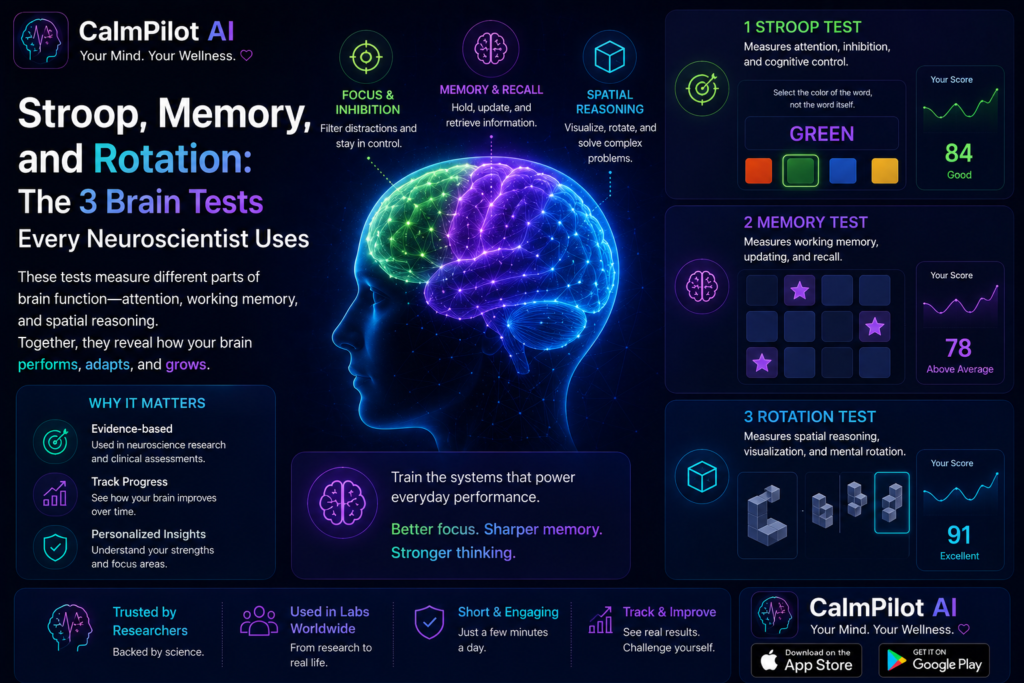
The Stroop test, the working memory test, and the mental rotation test have each generated thousands of peer-reviewed studies. Together they map three distinct pillars of cognitive function: your brain’s ability to control itself, hold information in mind, and mentally manipulate space. Here is what each one measures, why neuroscientists trust it, and what your performance actually reveals.
1. The Stroop Test: Measuring the Brain’s Ability to Override Itself
The Stroop test is deceptively simple. You are shown colour words — RED, BLUE, GREEN — printed in a mismatched ink colour. The word RED might be printed in blue ink. Your task: name the ink colour, not the word.
Try it once and you will immediately feel the friction. Something in your brain wants to say “red” when it sees the word RED, even though the ink is clearly blue. That resistance, the effort required to say the right answer, is not a character flaw. It is your brain’s automatic reading process colliding with your intention — and the time it takes you to resolve that collision is precisely what the Stroop test measures.
The Stroop effect demonstrates that reading is so deeply automated in literate adults that we cannot simply switch it off — even when it works against us.
What the Stroop Test Actually Measures
The delay between naming congruent colours (word and ink match) and incongruent colours (word and ink differ) is called the Stroop interference effect. The size of that gap reveals the efficiency of several overlapping systems:
- Executive function — specifically your ability to inhibit a dominant, automatic response in favour of a less automatic one.
- Selective attention — how well you can focus on one stimulus dimension (ink colour) while suppressing another (word meaning).
- Cognitive processing speed — how quickly your prefrontal cortex can arbitrate between competing signals.
- Cognitive flexibility — the speed at which you can shift between response rules.
These are all functions of the prefrontal cortex, the region most responsible for what psychologists call executive control — planning, decision-making, impulse regulation, and the ability to override habits. The Stroop test is, in essence, a direct window into prefrontal health.
Why Neuroscientists Use It
Stroop performance degrades in predictable, measurable ways with age, chronic stress, sleep deprivation, ADHD, early-stage dementia, and traumatic brain injury. It is sensitive enough to detect changes before a person notices symptoms themselves, which is why it appears in clinical assessment batteries worldwide.
Conversely, improved Stroop performance — a smaller interference effect — is one of the clearest indicators that cognitive training, medication, or therapeutic intervention is working. If your brain is getting better at managing itself, the Stroop test is among the first to show it.
2. The Working Memory Test: Measuring Your Brain’s Whiteboard
Working memory is not the same as memory. It is the system your brain uses to hold information actively in mind while doing something with it — the cognitive equivalent of a whiteboard. When you keep a phone number in your head while dialling, follow a multi-step instruction, or hold the beginning of a sentence in mind while you reach the end of it, you are using working memory.
Neuroscientists measure it in several ways, with the most well-validated being the digit span test, the N-back task, and various spatial working memory paradigms.
Digit Span: The Classic Measure
The digit span test presents a sequence of numbers — 3, 7, 1, 9, 4 — and asks you to repeat them back immediately. The sequence grows longer with each trial until you fail. Most healthy adults can hold 7 items (plus or minus 2), a number so reliable that psychologist George Miller famously called it “the magical number seven” in a 1956 paper that has been cited over 22,000 times.
Forward digit span measures raw capacity. Backward digit span — repeating the sequence in reverse — adds a manipulation demand, and is a far more sensitive measure of working memory function because it requires you to simultaneously hold and reorder information.
The N-Back Task: Working Memory Under Continuous Load
The N-back task is more demanding and more revealing. You see a continuous stream of stimuli — letters, shapes, positions on a grid — and your task is to indicate whenever the current item matches the one that appeared N steps ago. In a 2-back task, you press a button when the current letter matches the letter from two trials before.
This requires you to simultaneously update, hold, and compare information in real time, under a continuous cognitive load. It is the closest laboratory approximation of the demands that real-world complex thinking places on your brain.
Working memory capacity correlates more strongly with general intelligence, academic achievement, and professional performance than almost any other single cognitive measure.
What Working Memory Performance Reveals
Low working memory capacity is strongly associated with:
- Difficulty following complex instructions
- Losing track in conversations or text
- Poor performance on standardised tests
- ADHD and learning difficulties
- Susceptibility to distraction
High working memory capacity is associated with higher fluid intelligence, better academic outcomes, faster skill acquisition, and stronger performance under cognitive load — the conditions that most demanding work environments create.
Unlike many cognitive traits, working memory is trainable. Consistent N-back training has been shown in multiple studies to produce real improvements in working memory capacity that transfer to untrained tasks — one of the few examples of cognitive training that genuinely generalises.
3. The Mental Rotation Test: Measuring Spatial Intelligence
The mental rotation test presents two three-dimensional objects and asks a single question: are they the same object, just rotated to a different angle, or are they mirror images of each other? Your task is to mentally spin one object in your head and compare it to the other.
Pioneered by Roger Shepard and Jacqueline Metzler in 1971 in a study that produced one of the most replicated findings in cognitive psychology, the mental rotation test revealed something remarkable: the time it takes to answer scales linearly with the angle of rotation. If an object needs to be mentally rotated 180 degrees, it takes roughly twice as long as a 90-degree rotation — as if the brain were physically rotating the object through space at a constant speed.
Mental rotation provides direct evidence that the brain does not just process symbols — it simulates physical space. Your mind performs something that genuinely resembles rotating an object in your hands.
What Mental Rotation Measures
Mental rotation performance is one of the primary measures of spatial intelligence — the ability to perceive, manipulate, and reason about objects and their relationships in space. The brain systems involved span the parietal cortex (spatial processing), the occipital cortex (visual representation), and the motor cortex (the simulation of physical rotation itself).
High mental rotation ability predicts:
- STEM performance — mathematics, physics, engineering, and chemistry all require spatial manipulation of abstract concepts.
- Surgical skill — surgeons with high rotation scores perform better on laparoscopic tasks, where instruments must be mentally mapped to what appears on screen.
- Architectural and design ability — visualising structures from multiple perspectives before they are built.
- Athletic performance in spatial sports — gymnastics, diving, martial arts, and ball sports all require rapid mental simulation of body positions in space.
- Navigation — the ability to maintain a mental map while moving through an environment.
Why It Is So Widely Used
Mental rotation is cross-culturally robust — it works across languages, educational backgrounds, and cultures in ways that verbal tests often do not. It shows consistent, well-characterised developmental trajectories from childhood through old age, making it ideal for both detecting decline and measuring improvement. It is also one of the few cognitive skills where researchers have documented genuine sex differences in performance — a finding that has generated substantial research into why those differences exist and whether training narrows them (it does).
The Three Tests Together: A Cognitive Map
Used together, the Stroop, working memory, and mental rotation tests give neuroscientists a three-dimensional picture of cognitive health:
- The Stroop test measures the brain’s ability to control itself — to override automatic responses, maintain focus, and act with intention rather than habit.
- Working memory tests measure the brain’s ability to hold and manipulate information — the active cognitive workspace that underlies complex thinking, learning, and reasoning.
- The mental rotation test measures the brain’s ability to simulate and manipulate space — the spatial intelligence that underlies a surprising range of technical and physical skills.
Together they map executive control, fluid intelligence, and spatial cognition — three systems that are largely independent, each trainable, and each sensitive to both lifestyle factors and deliberate practice.
What Affects Performance on All Three
Understanding what moves these scores is as useful as understanding what they measure. Research consistently shows that performance on all three tests is significantly affected by:
- Sleep quality. A single night of poor sleep measurably reduces Stroop performance, working memory capacity, and spatial reasoning accuracy — effects comparable to mild intoxication.
- Chronic stress. Elevated cortisol shrinks prefrontal cortex grey matter over time, degrading all three domains simultaneously.
- Aerobic exercise. Regular cardiovascular exercise increases BDNF (brain-derived neurotrophic factor), which promotes neuroplasticity in exactly the regions these tests measure.
- Cognitive training. Deliberate practice with tasks that target each domain — inhibition training for the Stroop, N-back for working memory, rotation tasks for spatial cognition — produces measurable, persistent improvements.
- Mood. Anxiety significantly slows Stroop performance. Depression degrades working memory capacity. Positive affect is associated with faster mental rotation. Your emotional state is never separate from your cognitive performance.
How to Train These Systems
The same properties that make these tests useful for measurement make them useful for training. The most effective cognitive training programmes target the same mechanisms the tests expose:
For Stroop / executive control: Any task requiring you to override a dominant response — switching between rules mid-task, ignoring irrelevant information, responding to one feature of a stimulus while suppressing another. Colour-matching games, task-switching exercises, and controlled distraction tasks all qualify.
For working memory: The N-back task is the gold standard. Start at 1-back (current item matches the previous one) and progress to 2-back and 3-back as accuracy improves. Dual N-back — tracking two independent streams simultaneously — is the most demanding and most rewarding variant.
For mental rotation: Any task requiring you to mentally manipulate 3D objects — puzzle games, spatial navigation challenges, pattern-matching with rotated shapes, or the physical practice of gymnastics, dance, and racquet sports all develop the same neural circuits.
CalmPilot AI includes games specifically designed around these three cognitive domains, with adaptive difficulty that adjusts to your performance level so you are always training at the edge of your current ability — the zone where neuroplasticity is highest.
The Bottom Line
The Stroop test, working memory tasks, and mental rotation assessments have remained at the centre of neuroscience not because of tradition but because of precision. Each one isolates a genuinely important cognitive system, produces reliable and reproducible results, and responds to training in ways that predict real-world performance improvements.
Your score on any of these tests today is not a fixed verdict. It is a baseline — a snapshot of where your brain is right now, shaped by your sleep, your stress, your habits, and your history of deliberate practice. All three systems are trainable at any age. The research on neuroplasticity is unambiguous on this point.
The question neuroscientists are no longer asking is whether these skills can improve. The question they are asking now is: how consistently, and by how much?