
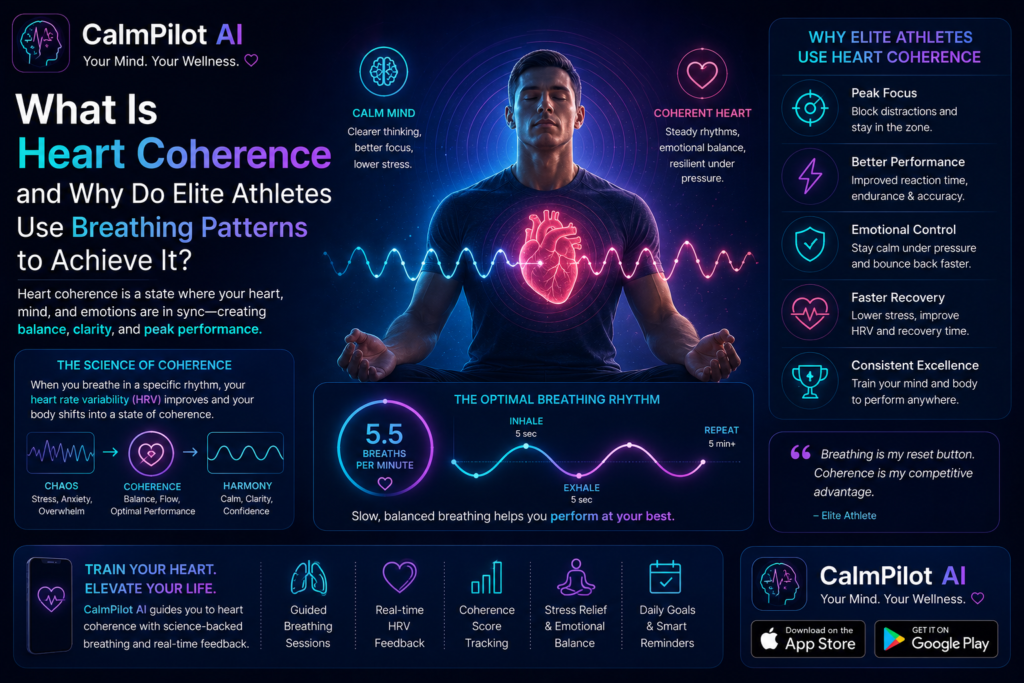
Before a penalty shootout, Cristiano Ronaldo takes a slow, deliberate breath. Before a world-record attempt, free-diver Guillaume Néry enters a state of near-total stillness. Before a crucial putt, elite golfers pause, breathe, and reset. These athletes aren’t performing a ritual — they’re engineering a specific physiological state called heart coherence. And the science behind it is changing how the world’s best performers train their minds.
What Is Heart Coherence?
Heart coherence is a measurable state in which your heart rhythm becomes smooth, ordered, and rhythmically consistent. Instead of the slightly erratic beat-to-beat variation you have at rest, a coherent heart produces a sine-wave-like pattern — elegant, regular, and synchronised.
This matters because your heart doesn’t just pump blood. It sends more signals to the brain than the brain sends to it. When the heart’s rhythm is coherent, the neural signals flowing upward to the brain actively reduce activity in the amygdala (your threat-detection centre) and sharpen function in the prefrontal cortex (your decision-making and focus centre).
Heart coherence isn’t relaxation. It’s a state of high-performance calm — aroused and alert, but not anxious or reactive.
The term was popularised by the HeartMath Institute, whose decades of research have shown that heart coherence produces measurable improvements in reaction time, cognitive accuracy, emotional resilience, and recovery from stress — all qualities that separate good athletes from elite ones.
Heart Rate Variability: The Number Behind the State
To understand heart coherence, you need to understand heart rate variability (HRV). HRV is the variation in time between consecutive heartbeats. A heart beating at 60 bpm doesn’t beat exactly once per second — the gap between beats fluctuates slightly, and this variability is a sign of health, not inconsistency.
High HRV indicates a nervous system that can shift fluidly between activation and recovery. Low HRV signals chronic stress, poor recovery, or overtraining. Elite athletes obsessively track HRV because it is one of the most reliable indicators of readiness to perform.
Heart coherence is a specific pattern within HRV data — not just high variability, but variability that forms a smooth, rhythmic wave. Think of it as the difference between a stock chart spiking randomly and one rising and falling in a perfect, predictable curve. Both have variability. Only one is coherent.
Why Athletes Train for Heart Coherence
The benefits of heart coherence are not theoretical — they show up directly in performance metrics that coaches and sports scientists care about:
- Faster recovery between efforts. Coherence accelerates the return from sympathetic (fight-or-flight) to parasympathetic (rest-and-digest) states. An athlete who recovers faster between sprints, sets, or matches has a measurable edge.
- Reduced cortisol under pressure. Pre-competition cortisol spikes impair fine motor control and decision-making. Coherence breathing blunts the spike without suppressing the adrenaline that drives performance.
- Improved reaction time and decision accuracy. When the prefrontal cortex receives coherent signals from the heart, cognitive processing speeds up. Studies using basketball free-throw accuracy and military marksman training both show measurable gains following coherence training.
- Emotional regulation under pressure. Choking under pressure is largely an amygdala hijack. Coherence training physically reduces the amygdala’s sensitivity to threat signals, making it harder to choke when it counts.
Teams in the NFL, NBA, and Premier League now include HRV monitoring and coherence training as standard in their performance programmes. The US Navy SEALs, Olympic shooting teams, and top-ranked tennis players have all documented coherence protocols in their preparation.
The Breathing Pattern That Triggers Coherence
Here is the key insight: you cannot will yourself into heart coherence. But you can breathe your way there. A specific breathing rhythm — inhaling and exhaling at a rate of approximately 5 to 6 breaths per minute — reliably induces a coherent heart rhythm within 60 to 90 seconds.
This is called resonance breathing or coherent breathing, and it works because it synchronises your breathing cycle with your heart’s natural resonance frequency. At this pace, the rhythmic pressure changes in your chest from breathing fall perfectly in phase with your heart’s beat-to-beat variation, creating the smooth sine-wave pattern of coherence.
The basic technique:
- Sit or stand comfortably with your spine straight.
- Inhale slowly through your nose for 5 seconds.
- Exhale slowly through your nose or mouth for 5 seconds.
- Continue for 5–10 minutes. (Benefits begin within 60–90 seconds.)
- Keep the breath gentle and even — no forced deep breathing required.
A 5-second in / 5-second out rhythm gives you exactly 6 breaths per minute. If that feels too slow to start, begin at 4 seconds each and work down. The critical thing is the equal ratio and the pace — not volume or effort.
Box Breathing: The Military Variant
US Navy SEALs use a variant called box breathing (or tactical breathing), which adds breath holds to the resonance rhythm. The four-sided structure gives it its name:
- Inhale for 4 seconds
- Hold for 4 seconds
- Exhale for 4 seconds
- Hold for 4 seconds
The holds serve a specific purpose: they extend the duration of each breath cycle, slowing the overall rate closer to resonance frequency while also increasing CO₂ tolerance — useful in high-stress situations where shallow, rapid breathing is a risk. Special operations personnel use this technique to maintain accuracy during high-intensity entries, when most people’s fine motor control collapses under adrenaline.
The Physiology: Why Slow Breathing Works
Slow, rhythmic breathing works through multiple overlapping mechanisms:
Vagal stimulation. The vagus nerve — the longest nerve in your body — runs from your brainstem through your heart, lungs, and gut. It is the primary cable of your parasympathetic nervous system. Every slow exhale stretches receptors in your lungs that directly stimulate the vagus nerve, sending a “safe” signal to your brain and slowing heart rate. Coherence breathing maximises this stimulation with every cycle.
Baroreflex synchronisation. Baroreceptors in your aorta and carotid arteries monitor blood pressure and signal the autonomic nervous system to adjust heart rate accordingly. At resonance breathing frequency, this feedback loop synchronises perfectly with the breathing rhythm, amplifying both HRV and coherence.
Reduced sympathetic tone. Slow breathing reduces the firing rate of sympathetic nerve fibres to the heart, lowering cortisol output and decreasing the body’s baseline threat-readiness — without eliminating the alert readiness that performance demands.
Coherence is the sweet spot between arousal and calm. It is not the absence of stress — it is stress made useful.
How Long Does It Take to See Results?
The acute effects — a measurable shift in HRV coherence — appear within 60 to 90 seconds of beginning resonance breathing. This is why athletes use it in the locker room, on the starting blocks, or between sets.
The longer-term effects build over weeks of consistent practice:
- 1–2 weeks: Baseline HRV begins to rise. Stress recovery becomes faster.
- 3–4 weeks: Resting heart rate drops slightly. Sleep quality improves. Athletes often report feeling “less reactive” to setbacks.
- 6–8 weeks: Prefrontal cortex density has been shown to increase in neuroimaging studies. Amygdala reactivity measurably decreases.
- 3+ months: Sustained coherence training is associated with reduced inflammatory markers, improved immune function, and lasting changes in emotional regulation — effects that persist even without active practice sessions.
The minimum effective dose is 5 minutes of coherence breathing per day. Elite athletes often practise 10–20 minutes daily, with additional short sessions before competition.
Heart Coherence for Non-Athletes
You don’t need to be competing at an elite level to benefit from heart coherence training. The same mechanisms that help a sprinter recover faster between heats help an office worker recover faster between stressful meetings. The same prefrontal boost that sharpens an athlete’s decision-making under pressure sharpens a parent’s patience at the end of a long day.
The stressors are different. The nervous system is the same.
Research has shown measurable benefits for:
- People with generalised anxiety disorder
- Individuals with high workplace stress
- Students before exams
- People recovering from cardiovascular events (under clinical guidance)
- Anyone experiencing chronic low-grade stress — the kind that never fully resolves
How to Start: A Practical Protocol
You don’t need a biofeedback device to begin. Start with this simple daily protocol:
Morning (5 minutes): Before checking your phone, sit upright and practise resonance breathing — 5 seconds in, 5 seconds out. This sets your HRV baseline for the day in a positive direction.
Pre-stress (60–90 seconds): Before a difficult meeting, difficult conversation, or any known stressor, use the same rhythm. Even one minute shifts your autonomic state measurably.
Recovery (5 minutes): After a high-stress event, use coherence breathing to accelerate the return to baseline instead of letting cortisol linger for hours.
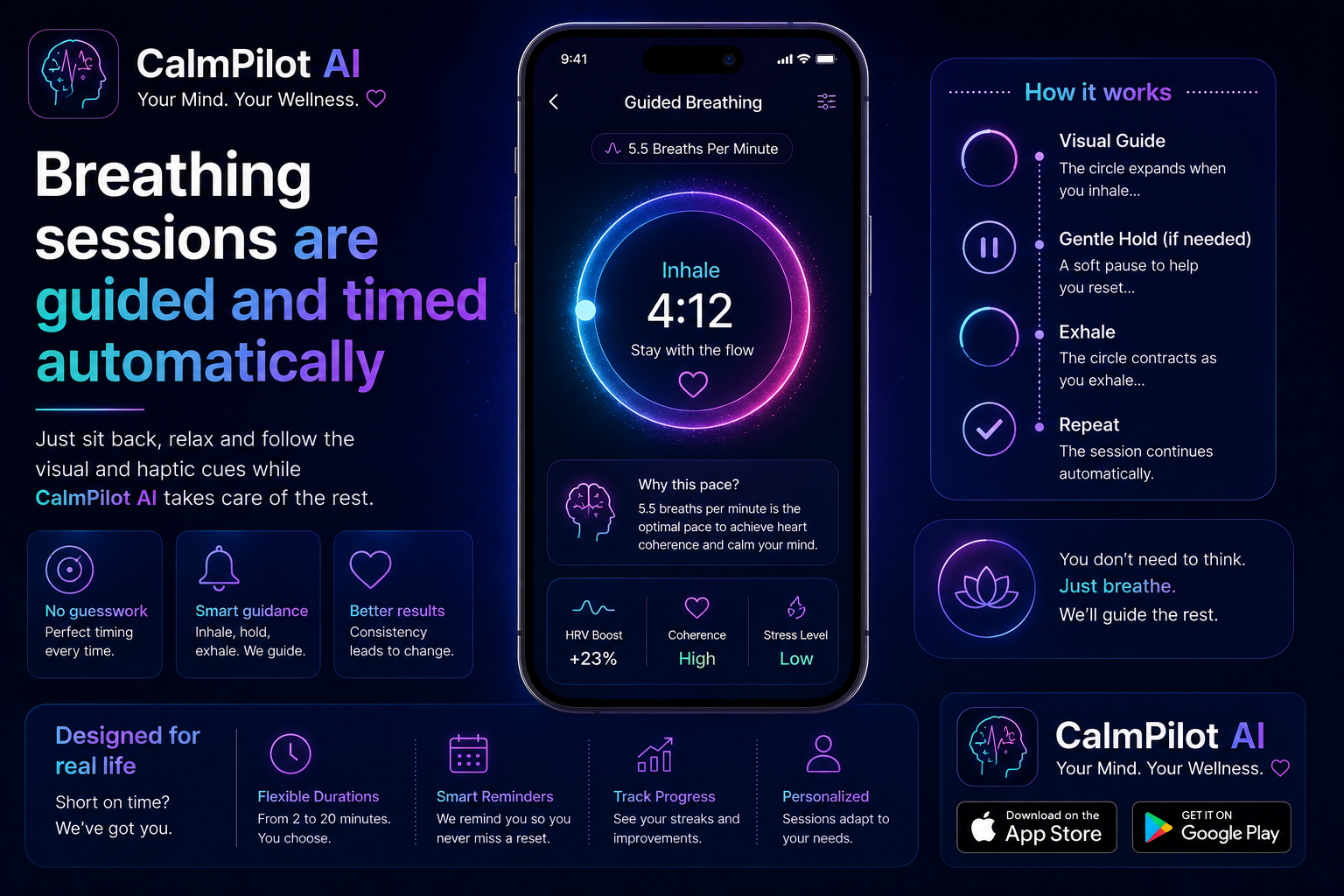
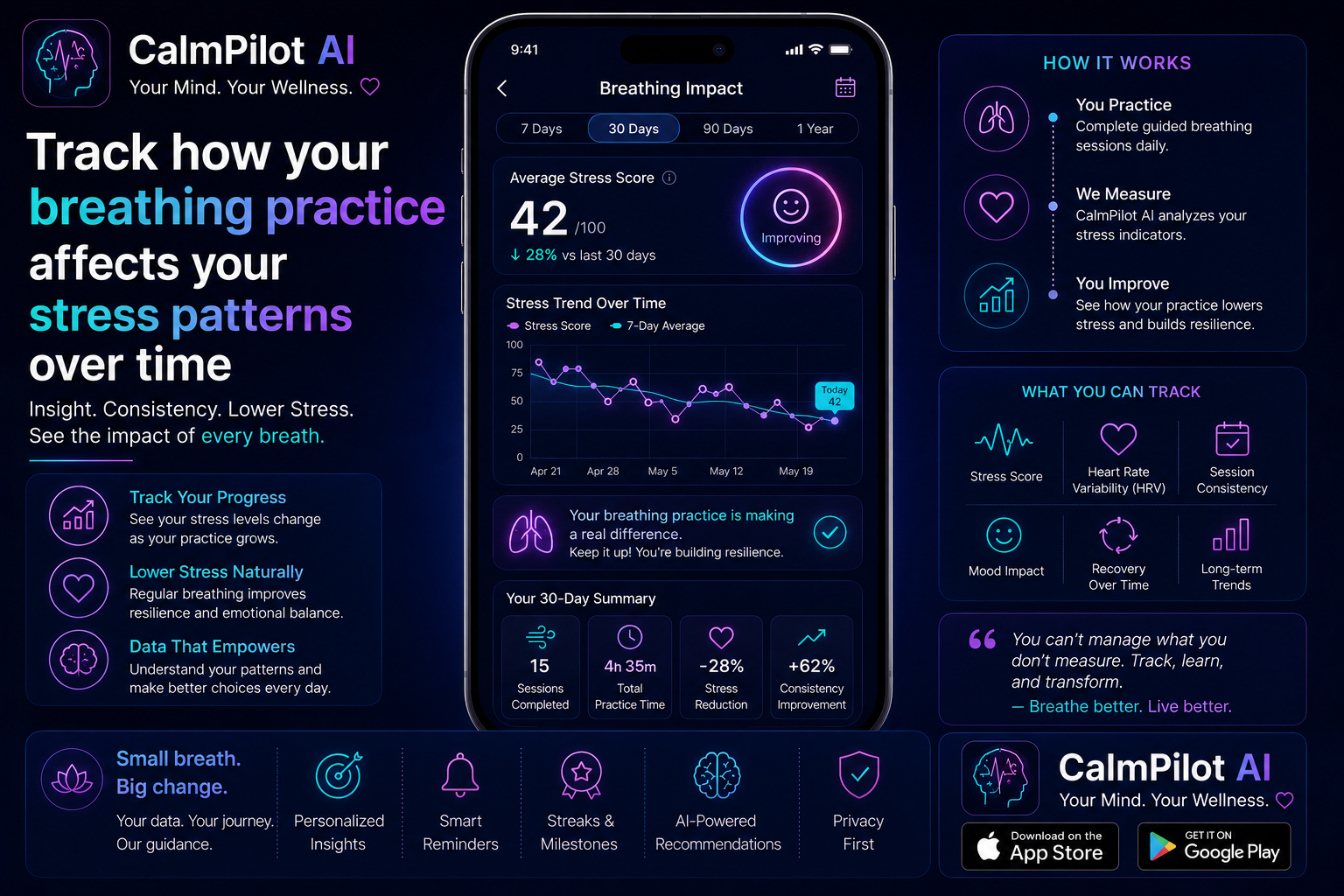
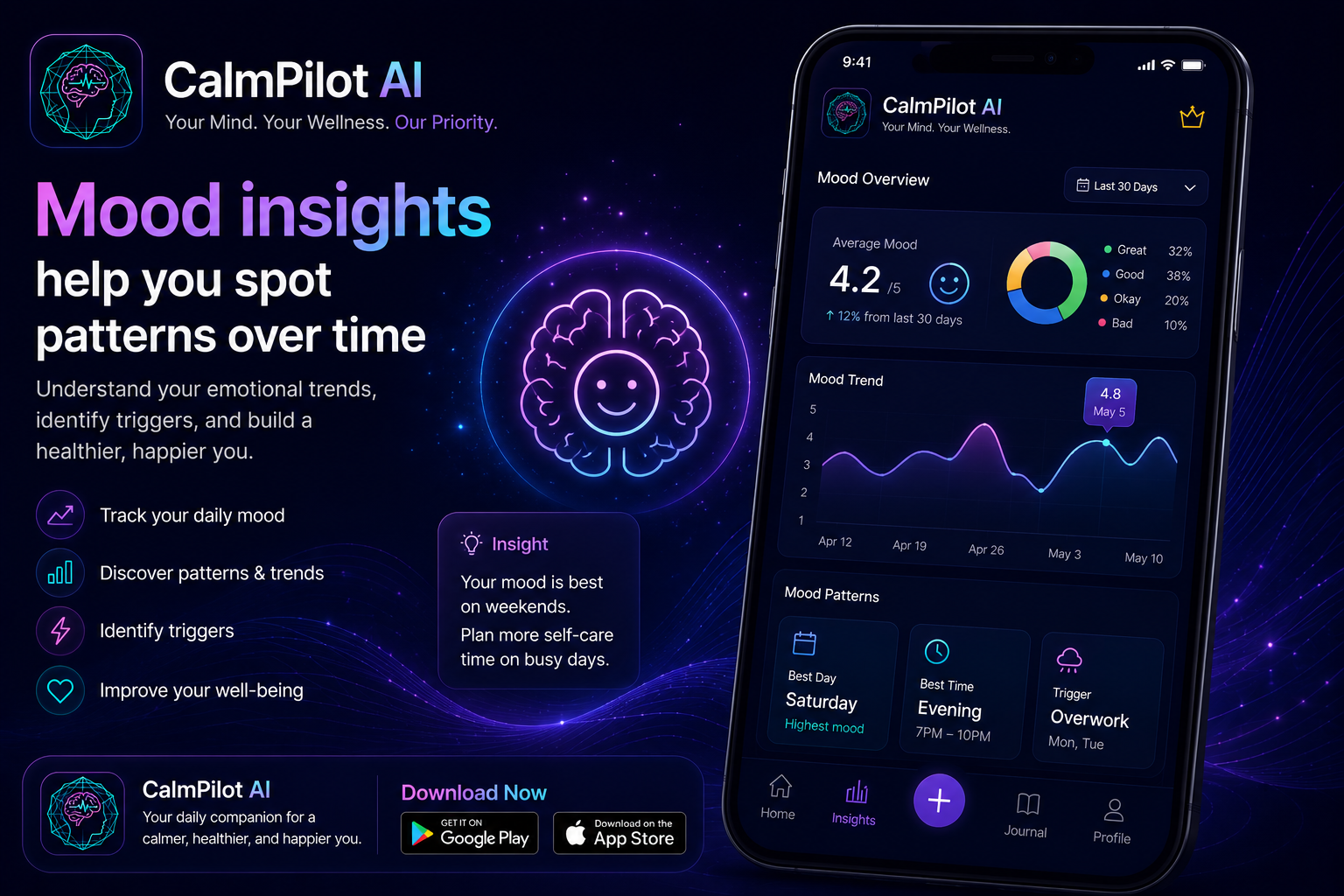
CalmPilot AI includes guided breathing sessions paced to resonance frequency so you don’t need to count or watch a timer — the visual guide does it for you, and your session is logged so you can see how your practice correlates with your mood and stress patterns over time.
Measuring Your Progress
If you want to track coherence directly, consumer wearables like the Polar H10 chest strap, Garmin devices, WHOOP, and Apple Watch all provide HRV data. Apps like the HeartMath Inner Balance sensor provide real-time coherence scoring.
But the simplest measure is your own mood data. People who practise coherence breathing consistently report:
- Feeling less “triggered” by minor stressors
- Returning to calm faster after difficult moments
- Sleeping more soundly
- Feeling more present during conversations and tasks
These subjective improvements correspond directly to the objective HRV data — which means you don’t need a sensor to know your practice is working. You’ll feel the difference before you measure it.
The Bottom Line
Heart coherence is not a wellness trend or a meditation buzzword. It is a precisely defined physiological state with decades of peer-reviewed research behind it, adopted by the world’s highest-performing athletes and military units because it measurably improves performance under pressure.
The breathing pattern that produces it — slow, rhythmic, approximately 6 breaths per minute — is free, requires no equipment, and begins working in under two minutes. The only investment is consistency.
Elite athletes don’t breathe slowly before competition because it feels nice. They do it because it works. The question is whether you’re ready to use the same tool.