
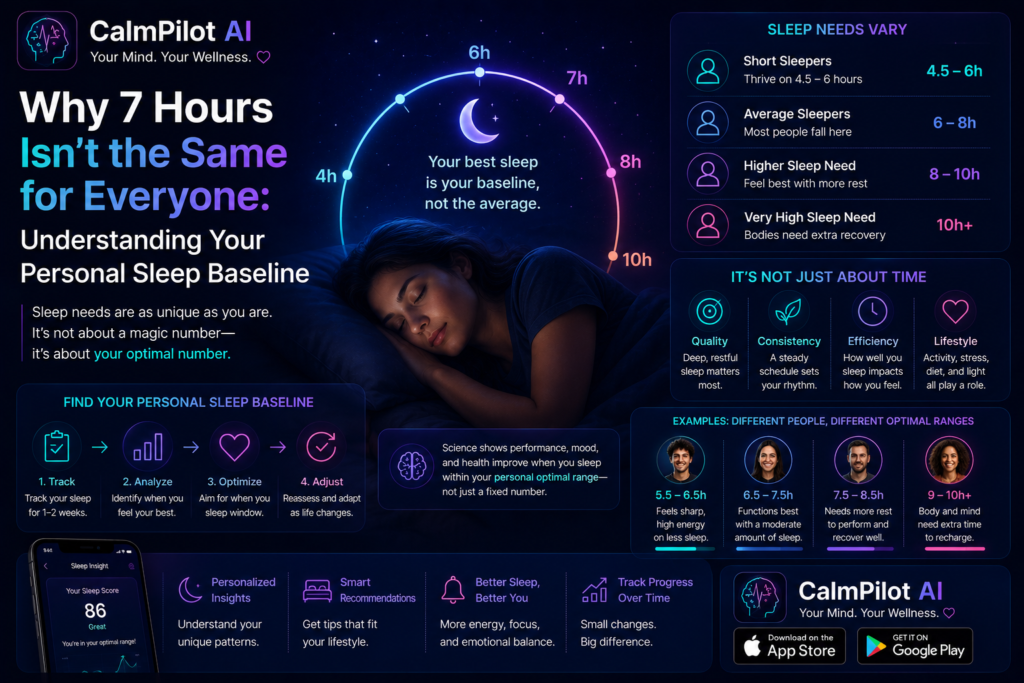
Seven hours. Eight hours. The advice changes depending on which headline you read, which study your doctor quotes, or which wellness influencer you follow. Most people treat sleep duration as a simple target — hit the number, feel fine. But the number is only half the story, and for many people it is the less important half.
The emerging science of sleep biology is clear on one thing: the amount of sleep you personally need is not the same as the amount your colleague, partner, or sibling needs — and the gap between individuals is larger than most people realise. Understanding your own baseline is one of the most impactful things you can do for your mental health, cognitive performance, and long-term physical wellbeing.
Where the “7–8 Hours” Rule Comes From
The recommendation to sleep seven to nine hours per night comes from large epidemiological studies tracking health outcomes across populations. It is a statistical median — the range within which the majority of adults show the lowest rates of cardiovascular disease, obesity, cognitive decline, and all-cause mortality.
It is a useful public health guideline. It is not a biological law that applies equally to every human being.
Population averages describe the middle of a distribution. They say nothing about the tails. And when it comes to sleep, the tails are wide. Some people function optimally on six hours. Others need nine to feel genuinely rested. A minority — estimated at fewer than 3% of the population — carry rare genetic variants that allow them to thrive on as little as four to six hours without any measurable cognitive or health deficits.
The question is not whether you sleep enough hours. The question is whether you sleep enough for you — and those are different questions with different answers.
The Genetics of Sleep Need
Your baseline sleep requirement is substantially heritable. Twin studies consistently show that 40–70% of the variation in sleep duration between individuals is explained by genetics rather than environment or lifestyle.
Several specific gene variants have been identified that alter how much sleep a person requires:
- DEC2 (BHLHE41): A rare mutation in the DEC2 gene — found in fewer than 1% of people — allows carriers to sleep 6 hours or less and wake feeling fully rested, with no measurable performance decline on cognitive tests. People without this mutation who sleep the same hours show significant impairment.
- ADRB1: A variant in the ADRB1 gene has been linked to natural short sleep — carriers sleep around 6.3 hours on average compared to 8.1 hours in non-carriers, with equivalent cognitive outcomes.
- NPSR1 and PER3: Variants in these genes influence both sleep duration preferences and chronotype — the time of day at which sleep naturally occurs. PER3 variations in particular are strongly linked to morning-type versus evening-type biology.
The practical implication: if you have always needed more sleep than peers who seem to thrive on less, it is almost certainly biological, not a weakness. If you have always woken naturally at six hours feeling genuinely alert, that is not sleep deprivation. That may simply be your genome.
Chronotype: It Is Not Just About How Long, But When
Chronotype is your genetically influenced preference for the timing of sleep and wakefulness. It is the reason some people are sharp at 6 a.m. while others hit their cognitive peak at 10 p.m. — and it is far more fixed than most people assume.
Chronotypes exist on a spectrum from extreme morning types (“larks”) to extreme evening types (“owls”), with most people distributed across the middle. Research by chronobiologist Till Roenneberg, who collected sleep data from over 50,000 people, found that only about 13% of the population are genuinely morning types; roughly 21% are clear evening types; and the remaining 66% fall somewhere between.
This matters for your sleep baseline because sleeping against your chronotype is not neutral. A confirmed evening-type person forced to wake at 6 a.m. for a 9-to-5 job is not just tired — they are experiencing what researchers call social jetlag: a chronic misalignment between biological sleep time and socially imposed wake time. Social jetlag has been independently associated with higher rates of obesity, depression, cardiovascular disease, and reduced cognitive performance — even when total sleep hours appear adequate.
Your personal sleep baseline, properly defined, includes not just how much sleep you need but when that sleep needs to occur for it to be restorative.
Sleep Quality vs Sleep Quantity: Why the Hours Alone Mislead
Two people can both sleep eight hours and wake up in entirely different states — because the restorative value of sleep depends not just on duration but on architecture: the sequence and proportion of sleep stages.
A full night of healthy sleep cycles through four stages repeatedly:
- N1 (light sleep): The transition from wakefulness. Accounts for about 5% of sleep in healthy adults. Easy to wake from.
- N2 (consolidated light sleep): Heart rate slows, body temperature drops, sleep spindles (brief bursts of neural activity) consolidate motor and procedural memories. About 45–55% of total sleep.
- N3 (slow-wave or deep sleep): The physically restorative stage. Growth hormone is released, cellular repair occurs, the glymphatic system clears metabolic waste from the brain — including amyloid proteins linked to Alzheimer’s disease. Hardest to wake from. About 15–25% of sleep in healthy young adults, declining with age.
- REM (rapid eye movement): Emotionally restorative sleep. Emotional memories are processed and regulated, creative connections are consolidated, stress hormones are metabolised. About 20–25% of sleep.
Alcohol, sleep apnoea, stress, blue light exposure, and inconsistent sleep schedules all preferentially disrupt deep sleep and REM — meaning you can clock eight hours on paper while your brain receives the restorative value of five. This is why so many people who “get enough sleep” still wake exhausted.
Sleep duration is what you measure with a clock. Sleep quality is what determines whether that duration actually restores you.
How to Find Your Personal Sleep Baseline
Your personal baseline is the sleep duration and timing that leaves you waking without an alarm, feeling alert within 20 minutes of rising, sustaining energy through the day without caffeine dependency, and falling asleep within 20–30 minutes of your intended bedtime. Here is how to find it:
The Two-Week Free-Sleep Method
The most reliable way to identify your natural sleep need is to remove all artificial constraints for two weeks. This requires a holiday or a period where you have no fixed morning obligations:
- Go to bed when you feel genuinely sleepy — not at a fixed clock time.
- Do not set an alarm. Wake only when your body wakes naturally.
- Avoid alcohol, which disrupts sleep architecture in ways that mask your true pattern.
- Maintain this for at least 14 days. The first few nights may be extended recovery sleep if you have accumulated sleep debt — discard those from your baseline calculation.
- From day 5 onward, your natural sleep duration and bedtime will stabilise. That stabilised pattern is your baseline.
Most people discover their natural sleep need is 30–90 minutes longer than what they actually get on weeknights. That gap is sleep debt — and it compounds.
Daytime Signals That Reveal Your Baseline
If a two-week free-sleep period is not possible, your daytime behaviour provides strong proxy signals:
- Caffeine dependency: If you cannot function without coffee in the morning and experience significant afternoon energy crashes, you are likely operating below your sleep baseline.
- Weekend sleep overshoot: Sleeping significantly longer on weekends (90+ minutes) than weekdays is a reliable marker of chronic weekday sleep restriction.
- Microsleep: Briefly dozing during passive activities — meetings, reading, watching a screen — indicates a sleep-deprived nervous system regardless of how many hours you think you slept.
- Mood volatility: Short-temperedness, emotional reactivity, and reduced frustration tolerance are often the first signs of sub-baseline sleep, appearing before subjective fatigue does.
- Reaction time degradation: Psychomotor vigilance tasks — simple reaction time tests — are among the most sensitive objective measures of sleep deprivation. A 5-minute reaction time test tells researchers more than a sleep diary.
Age Changes Your Baseline — But Not the Way You Think
A common misconception is that older people need less sleep. The evidence does not support this. What changes with age is not sleep need but sleep ability — specifically, the capacity to generate sufficient deep (N3) sleep.
Adults over 60 produce significantly less slow-wave sleep than younger adults even when given the same sleep opportunity. They also experience more fragmented sleep, earlier natural wake times, and greater sensitivity to environmental disruptions. The sleep need remains roughly the same. The architecture deteriorates.
This means older adults who sleep fewer hours are often not sleeping less because they need less — they are sleeping less because the brain’s capacity to maintain continuous, deep sleep has declined. Addressing the quality (through sleep hygiene, reducing alcohol, treating sleep apnoea, managing stress) often produces more benefit than simply attempting to extend the hours.
Sleep Baseline by Life Stage: Rough Reference Ranges
While individual variation exists within every age group, these ranges reflect current consensus from the American Academy of Sleep Medicine and the Sleep Research Society:
- School-age children (6–12): 9–12 hours
- Teenagers (13–18): 8–10 hours — and genuine biological night-owl chronotype, not a lifestyle choice
- Young adults (18–25): 7–9 hours, with chronotype often remaining evening-shifted
- Adults (26–64): 7–9 hours, with individual variation between 6 and 10
- Older adults (65+): 7–8 hours sleep opportunity, accepting that architecture limits may prevent all of it being restorative
Note what these ranges have in common: they are all ranges, not single numbers, and they all contain people who sit legitimately outside them.
Optimising Around Your Baseline, Not Against It
Once you have a reasonable estimate of your personal sleep baseline, the most productive approach is to build your schedule around it rather than fighting it. This sounds obvious. In practice, almost no one does it.
Practical steps that make a genuine difference:
- Protect your wake time first. A consistent wake time anchors your circadian rhythm more powerfully than a consistent bedtime. Pick a wake time you can maintain every day — including weekends — and hold it.
- Count backward from your wake time. If your baseline is 7.5 hours and you wake at 6:30 a.m., your lights-out target is 11 p.m. Treat this with the same priority as a morning appointment.
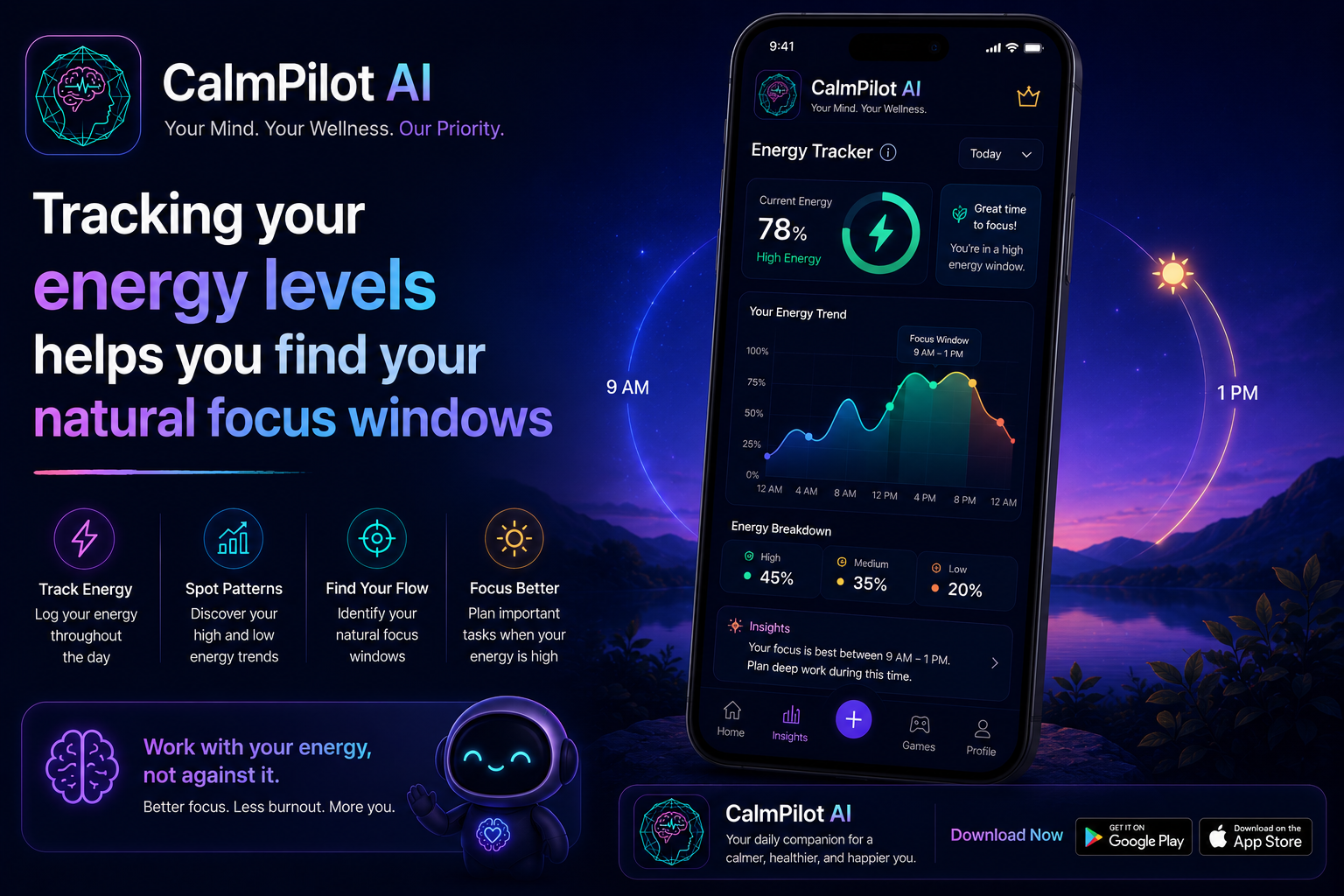
- Track your mood and energy, not just your hours. Sleep hours logged in an app tell you duration. How you feel at 10 a.m., 2 p.m., and 6 p.m. tells you whether that duration was restorative. Both signals together are far more useful than either alone.
- Respect your chronotype on weekends when possible. If you are an evening type, using weekends to sleep closer to your natural schedule (rather than forcing yourself up at 7 a.m.) reduces social jetlag and improves weekday baseline recovery.
- Address quality before quantity. If you are already sleeping 7–8 hours but wake unrefreshed, adding a ninth hour will not fix poor deep sleep. Improving sleep hygiene, managing evening stress, and reducing alcohol will.
The Bottom Line
Seven hours is a population median, not a personal prescription. Your sleep need is shaped by your genetics, your age, your chronotype, and the quality of the sleep architecture your brain produces — none of which are captured by a clock.
Finding your personal sleep baseline requires paying attention to how you actually feel across the day: your energy curve, your mood stability, your cognitive sharpness, your reliance on caffeine. These signals are more honest than any number of hours you can report on a sleep tracker.
The goal is not to sleep a specific number of hours. The goal is to sleep your number — consistently, at the right time for your biology, and with enough quality that the hours you do sleep actually count.
Everything else — your mood, your focus, your resilience, your relationships — is downstream of that.