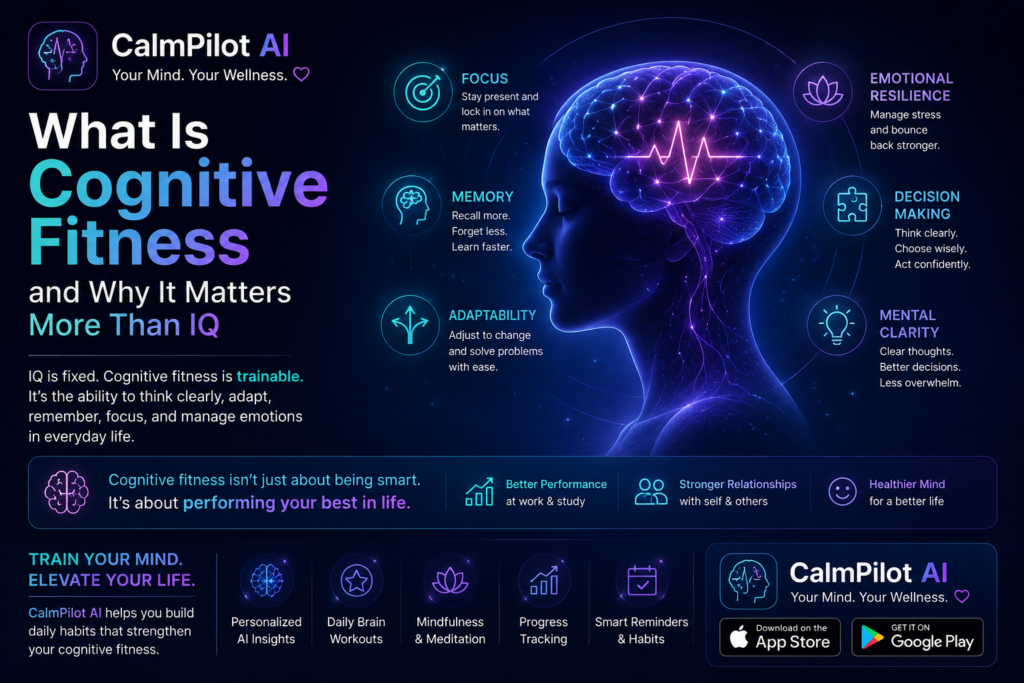
Most people have a number in their head when they think about intelligence — their IQ, their school grades, the vague sense of whether they are “smart” or not. That number feels fixed. Something assigned to you at birth, stable across your lifetime, largely out of your control.
Cognitive fitness is a different concept entirely — and in many ways, a more useful one. Where IQ measures a static snapshot of certain cognitive abilities, cognitive fitness describes the current, dynamic state of how well your brain is actually functioning: how sharp your attention is, how fast you process information, how effectively you manage competing demands, how clearly you think under pressure. And unlike IQ, cognitive fitness fluctuates. It responds to sleep, stress, exercise, nutrition, mental stimulation, and daily habits. Which means it can be trained, maintained, and improved.
Understanding cognitive fitness — what it is, what it consists of, and what degrades or strengthens it — is one of the most practical things you can do for your mental performance and long-term brain health.
What Is Cognitive Fitness? A Working Definition
Cognitive fitness is the overall capacity of your brain to perform mental tasks efficiently and adaptively. It is not a single ability but a composite of several distinct cognitive domains that work together in daily life:
- Working memory — the ability to hold and manipulate information in real time (following a conversation, doing mental arithmetic, reading a complex paragraph)
- Processing speed — how quickly your brain can perceive, interpret, and respond to information
- Sustained attention — the ability to maintain focus on a task over time without being pulled off course
- Executive function — the set of higher-order skills that govern planning, decision-making, impulse control, and cognitive flexibility
- Spatial reasoning — the ability to mentally visualise, manipulate, and reason about objects and relationships in space
- Memory consolidation — how effectively your brain encodes, stores, and retrieves information over time
A person with high cognitive fitness performs well across all of these domains — not because they are exceptionally intelligent, but because their brain is in good working condition: well-rested, well-stimulated, well-regulated, and regularly challenged.
Cognitive Fitness vs IQ: Why the Distinction Matters
IQ tests measure a narrow set of cognitive abilities — primarily fluid reasoning and verbal comprehension — under standardised conditions. They were designed to predict academic performance, and in that specific context, they do reasonably well. But IQ is largely stable across a lifetime, correlates strongly with early educational environment and socioeconomic background, and tells you very little about how your brain is performing on any given Tuesday afternoon.
Cognitive fitness, by contrast, is highly dynamic. The same person can have dramatically different cognitive performance depending on:
- How much sleep they got last night (one night of poor sleep reduces working memory capacity and processing speed measurably)
- Their current stress level (chronic stress physically shrinks the prefrontal cortex, reducing executive function and decision-making quality)
- How much physical activity they get (aerobic exercise increases BDNF — brain-derived neurotrophic factor — which directly improves memory and learning)
- Whether they are mentally challenged daily or cognitively coasting
- Their nutritional state, hydration, and social engagement
This dynamic quality is the key point: cognitive fitness is something you actively maintain or lose. A high IQ person who sleeps badly, lives under chronic stress, and never challenges their brain will perform cognitively worse in daily life than a moderate-IQ person who sleeps well, manages stress effectively, and keeps their brain regularly stimulated. The practical performance gap — the one that shows up in actual work, decisions, and relationships — favours fitness over raw intelligence.
IQ is the hardware you were given. Cognitive fitness is how well that hardware is running right now — and you have far more control over the second than the first.
The 5 Core Components of Cognitive Fitness Explained
1. Working Memory Capacity
Working memory is your brain’s active workspace — the mental scratch pad where you hold information while using it. When it is functioning well, you can follow complex instructions, track multi-step tasks, and engage meaningfully in demanding conversations. When it is degraded — by poor sleep, high stress, or lack of mental challenge — you lose your train of thought mid-sentence, forget why you walked into a room, and find yourself re-reading the same paragraph repeatedly. Working memory capacity is highly trainable through tasks that require active manipulation of held information, such as mental rotation and n-back exercises.
2. Processing Speed
Processing speed is how quickly your brain registers, interprets, and acts on incoming information. It affects everything from reaction time to reading speed to the ease of following fast-moving conversations. Processing speed declines naturally with age but degrades much faster under chronic stress and sleep deprivation — and can be maintained significantly longer with consistent cognitive training and physical exercise.
3. Executive Function
Executive function is the brain’s management system — housed primarily in the prefrontal cortex. It governs the ability to plan, prioritise, shift between tasks, suppress impulses, and regulate emotional responses. High executive function is what allows you to stay calm under pressure, make clear decisions when tired, and adapt when plans change. It is the domain most directly impaired by chronic stress and most directly strengthened by regular cognitive and physical training.
4. Sustained Attention
The ability to maintain focused attention on a single task over time — without being distracted by irrelevant stimuli or internal mind-wandering — is one of the most practically important cognitive skills in modern life, and one of the most under-trained. The average person’s sustained attention span has declined significantly in the past decade, corresponding closely with the rise of smartphone use and notification-driven environments. It is also one of the most directly trainable skills through focused cognitive games and deliberate attention practice.
5. Cognitive Flexibility
Cognitive flexibility — the ability to shift perspective, switch between mental frameworks, and adapt thinking to new information — is closely linked to creativity, emotional resilience, and problem-solving. Rigid thinking patterns, difficulty seeing multiple interpretations of a situation, and getting “stuck” in mental loops are all signs of reduced cognitive flexibility. It is trained by tasks that require perspective-shifting and pattern recognition across changing rules.
What Degrades Cognitive Fitness — and How Fast It Happens
The most important thing to understand about cognitive fitness is how quickly it responds to negative conditions — and how insidiously the degradation can happen without you noticing.
Sleep deprivation is the most potent acute cognitive impairment available without any external substance. One night of five hours of sleep produces cognitive deficits equivalent to being legally drunk — including in tasks that require working memory, processing speed, and executive judgment. After two weeks of consistently sleeping six hours, people report feeling fine while objectively performing significantly below their baseline. The subjective experience of tiredness disappears long before cognitive performance recovers.
Chronic stress causes structural brain changes with sustained exposure. Elevated cortisol over weeks and months measurably reduces grey matter density in the prefrontal cortex and hippocampus — the regions responsible for executive function and memory consolidation. These changes are partially reversible when stress is reduced, but recovery is slow.
Cognitive disuse — spending the majority of mental bandwidth on passive, low-demand activity (scrolling, watching, reacting) rather than active, challenging thinking — allows cognitive capacity to gradually erode. The brain optimises for what it does most. If it is never asked to work hard, it gets less capable of working hard.
Physical inactivity reduces cerebral blood flow, decreases BDNF production, and impairs the glymphatic system — the brain’s waste-clearance mechanism that operates primarily during sleep and physical rest. Regular aerobic exercise is one of the most evidence-supported interventions for maintaining cognitive fitness across the lifespan.
How to Build and Maintain Cognitive Fitness Daily
The evidence base for cognitive fitness improvement points to a consistent set of daily behaviours. None are dramatic. All are cumulative:
- Protect sleep above almost everything else. Seven to nine hours of quality sleep is the single highest-leverage action for daily cognitive performance. No supplement, training programme, or productivity system compensates for consistent sleep deprivation.
- Move your body daily. Even a 20-minute brisk walk produces measurable improvements in attention, processing speed, and mood for the following hours. Sustained aerobic exercise three to five times per week produces lasting structural brain benefits.
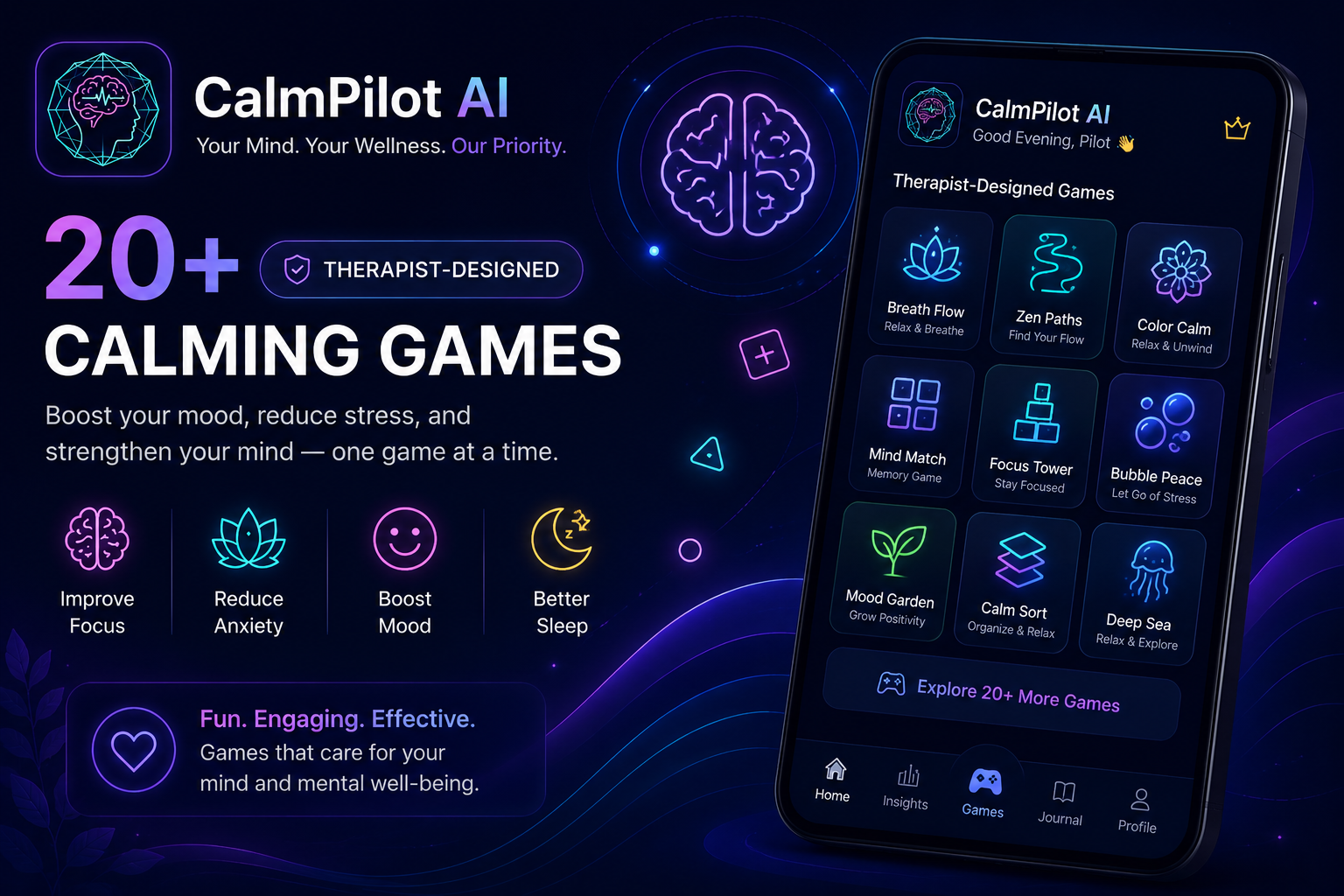
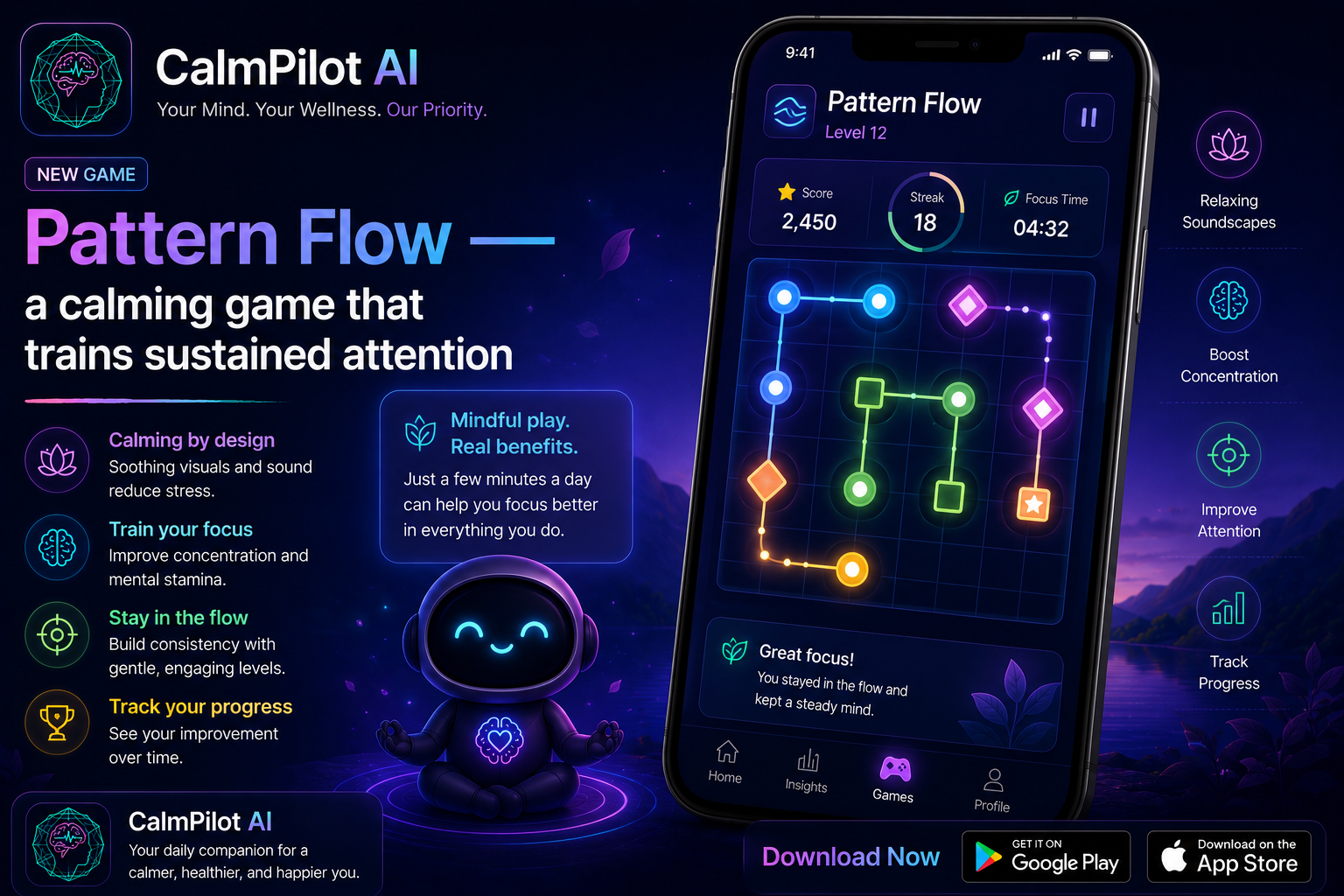
- Challenge your brain deliberately. Passive mental activity does not build cognitive fitness. Tasks that require active working memory use, strategic thinking, pattern recognition under time pressure, or perspective-shifting produce adaptive brain responses. Ten to fifteen minutes of targeted cognitive training daily is enough to produce measurable improvements within four to six weeks.
- Manage stress as a cognitive performance issue, not just an emotional one. Chronic stress is one of the most direct threats to cognitive fitness. Breathing practices, daily mood check-ins, and regular stress discharge (through movement, social connection, or processing conversations) protect the prefrontal cortex from the sustained cortisol exposure that degrades it.
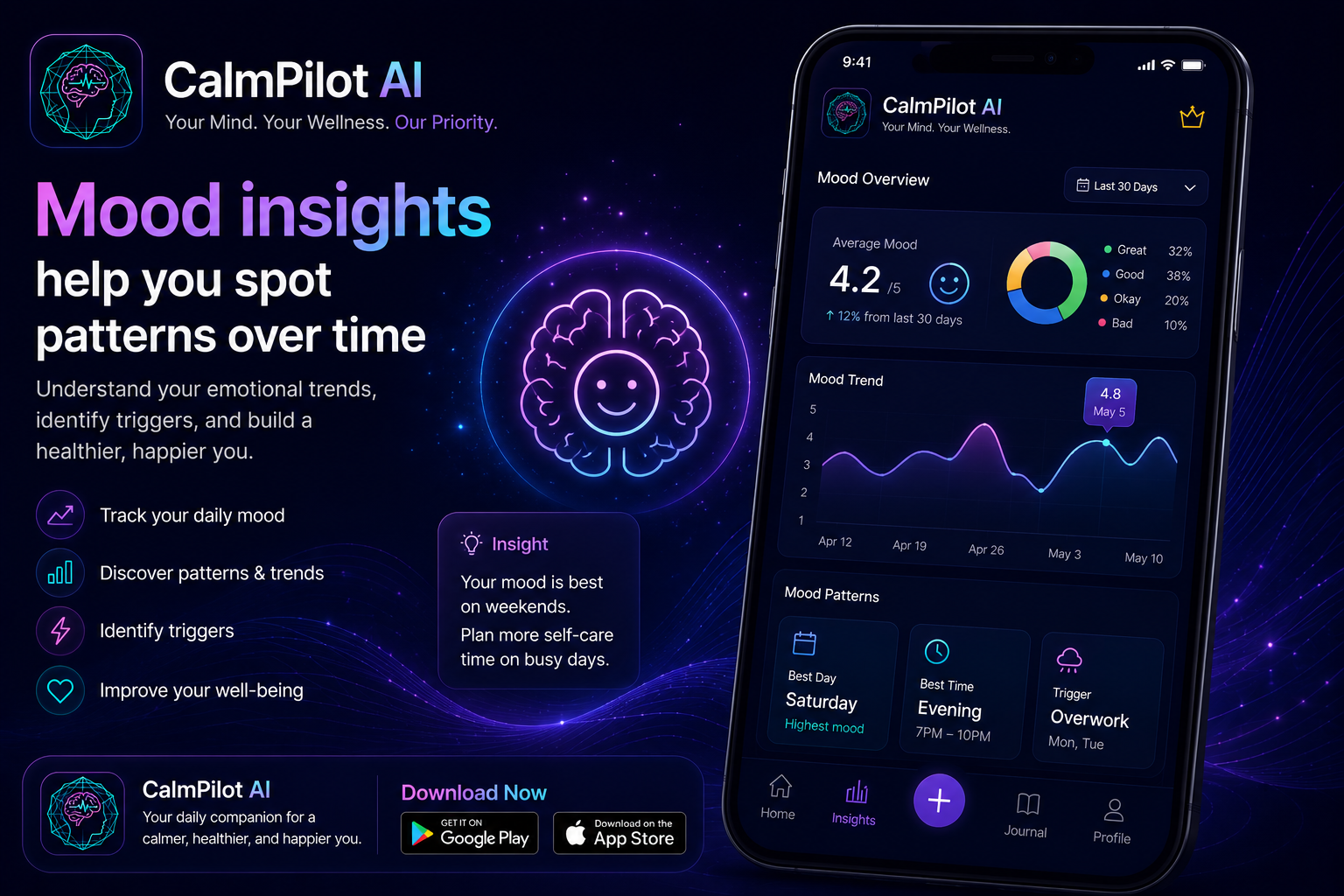
- Track patterns over time. Because cognitive fitness fluctuates, tracking how your performance and mood vary across the week reveals the conditions that support or undermine your best thinking — and lets you act on that information.
Why Cognitive Fitness Matters More Than IQ in Real Life
In the real world — the world of actual jobs, relationships, decisions under pressure, and problems that don’t have clean answers — what determines performance is not the ceiling of your cognitive potential but the quality of your cognitive functioning day to day.
A person with outstanding raw intelligence who is chronically sleep-deprived, highly stressed, and cognitively disengaged will consistently underperform relative to someone with more moderate baseline intelligence who sleeps well, manages stress effectively, and keeps their brain regularly challenged. The research on this is consistent and substantial.
More importantly: you cannot meaningfully raise your IQ. You can meaningfully raise your cognitive fitness. That makes cognitive fitness the more actionable and more empowering concept — the one that gives you genuine leverage over your mental performance, rather than something fixed and given.
Where to Start Building Your Cognitive Fitness
The most effective approach to cognitive fitness is not a single dramatic intervention. It is the accumulation of small, consistent actions that compound over weeks and months: protecting sleep, moving daily, challenging your brain deliberately, and managing stress before it degrades the hardware you’re trying to optimise.
Start with the factor that is most degraded right now. If you are sleeping badly, fix that first — everything else depends on it. If stress is chronically high, address that before anything else. If your daily mental activity is almost entirely passive, introduce ten minutes of active cognitive challenge and watch what happens to your focus within a fortnight.
Your brain is not fixed. It is not the IQ score from a test taken years ago. It is a living, changing system that responds to how you treat it — every single day.