
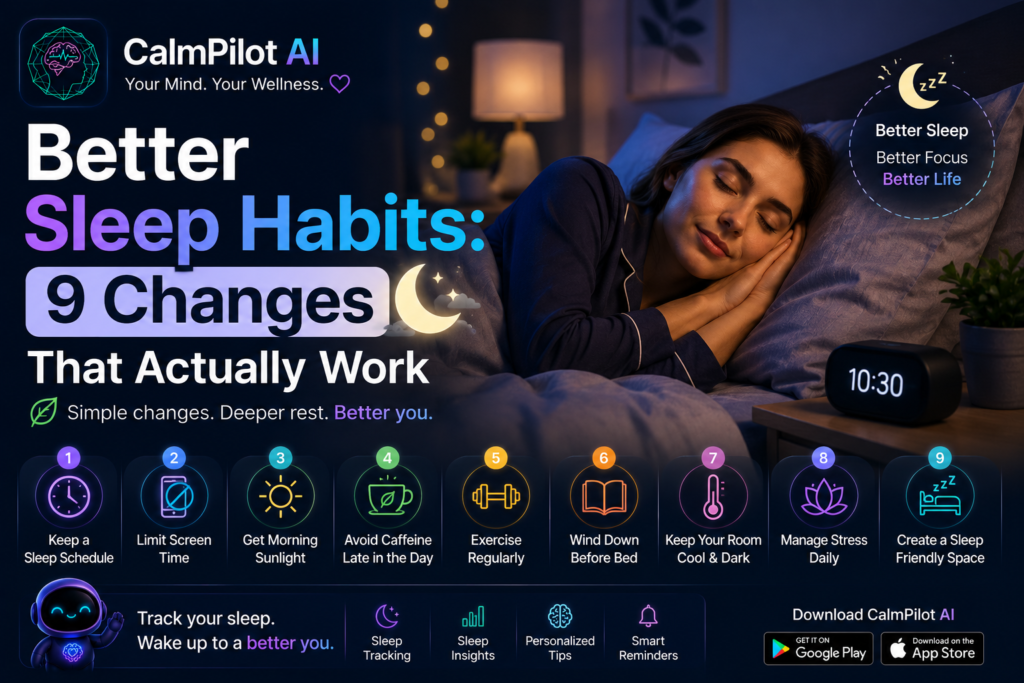
You’ve tried going to bed earlier. You’ve tried chamomile tea, white noise, and counting backwards from 300. And yet you’re still lying awake at 1 am with a brain that refuses to switch off. Poor sleep isn’t a minor inconvenience — it quietly erodes your mood, your focus, and your ability to handle stress the next day.
The good news: sleep responds remarkably well to consistent habits. You don’t need medication or a new mattress. You need the right signals, sent at the right time.
1. Fix Your Wake Time First (Not Your Bedtime)
Most sleep advice starts with “go to bed earlier.” But your body clock anchors itself to when you wake up, not when you sleep. A consistent wake time — even on weekends — is the single most powerful thing you can do for sleep quality.
Pick a wake time and hold it for two weeks, even if you had a rough night. Your sleep pressure (adenosine buildup) will naturally push you to fall asleep earlier, and your circadian rhythm will stabilise around that anchor.
Irregular wake times are one of the leading causes of social jet lag — a chronic misalignment between your body clock and your daily schedule that mimics the effects of actual jet lag, every single week.
2. Treat Light as Your Sleep Remote Control
Light is the primary signal your brain uses to set its internal clock. Getting bright light in the morning tells your circadian system it’s daytime — which then triggers a melatonin release roughly 14–16 hours later, making you sleepy at the right time.
Morning light habit (takes 5 minutes):
- Within 30–60 minutes of waking, get outside or sit near a bright window
- Even on cloudy days, outdoor light is 10–50x brighter than indoor lighting
- No sunglasses for this window — the light needs to reach your retinal cells
Evening light habit: dim your home lighting after sunset. Bright overhead lights and blue-heavy screens suppress melatonin for 2–3 hours after exposure, delaying your natural sleep onset.
3. Build a Wind-Down Routine (Even 20 Minutes)
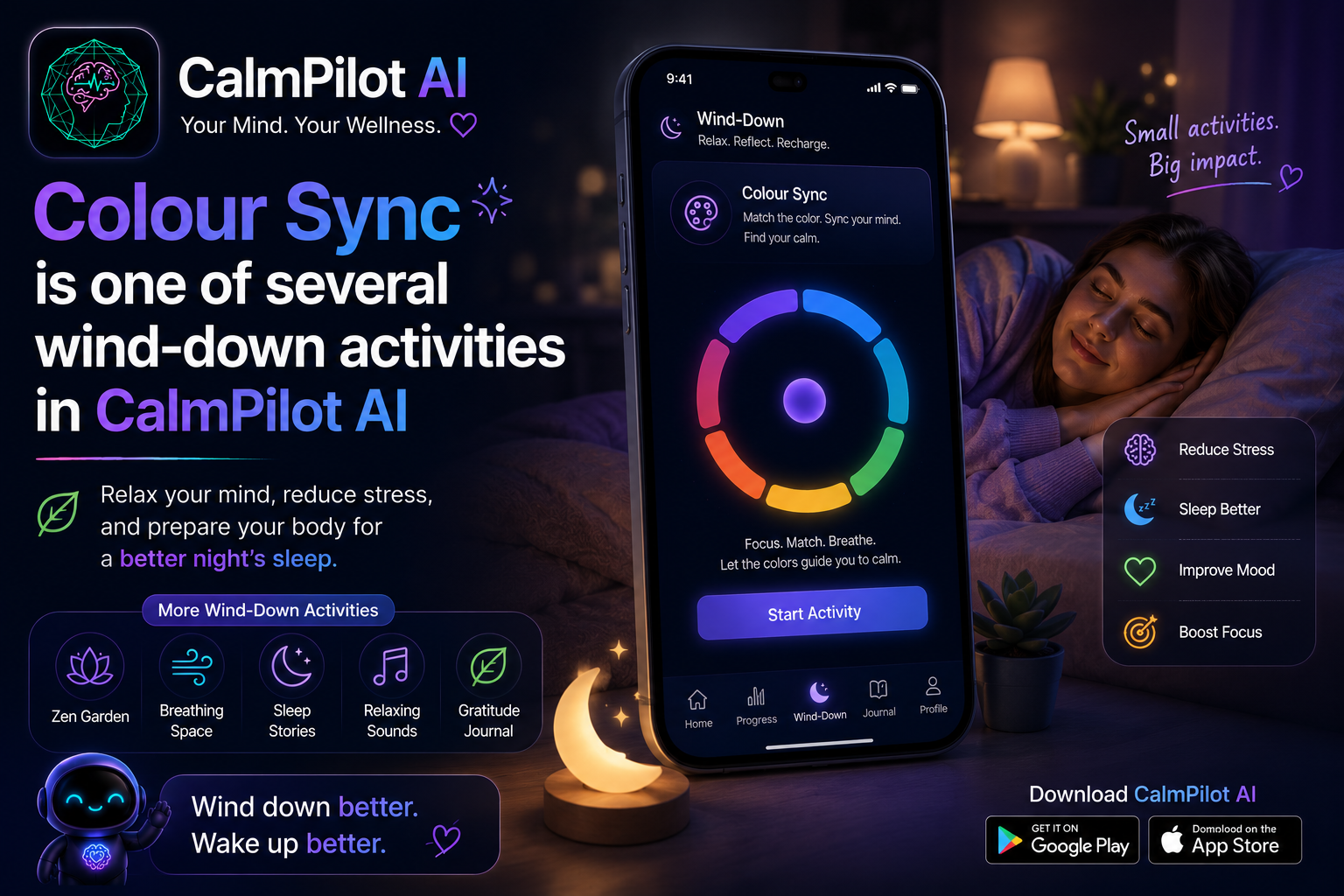
Your nervous system can’t switch from high-alert to sleep-ready instantly. A wind-down routine creates a buffer — a series of low-stimulation cues that signal to your brain that sleep is coming. The routine itself matters less than its consistency.
Simple 20-minute wind-down structure:
- Minutes 20–10: dim lights, put devices on do-not-disturb, make herbal tea or warm water
- Minutes 10–5: light stretching, journalling one sentence about tomorrow, or reading a physical book
- Minutes 5–0: in bed, slow breathing or a brief body scan
After 7–10 days of consistency, your body begins anticipating sleep at the start of the routine — before you even get into bed.
4. Keep Your Bedroom for Sleep Only
Your brain is an association machine. If you work in bed, scroll in bed, or watch TV in bed, your brain stops associating the bedroom with sleep — and starts associating it with alertness. This is called stimulus control, and undoing it is one of the most evidence-based interventions in sleep medicine.
The rule is simple: if you’re not sleeping (or winding down for sleep), don’t be in bed. If you lie awake for more than 20 minutes, get up and do something calm in dim light until you feel sleepy. Then return to bed. It feels counterintuitive, but it rebuilds the bedroom-sleep association quickly.
5. Watch the Caffeine Window
Caffeine has a half-life of 5–6 hours in most people — meaning a 3 pm coffee still has half its caffeine active at 9 pm. It doesn’t make you feel awake by adding energy; it works by blocking adenosine receptors — the same receptors that build sleep pressure throughout the day.
When caffeine wears off, all that accumulated adenosine floods back at once, which is why the afternoon crash can be so sharp. The fix isn’t more caffeine — it’s a consistent cutoff time.
Practical caffeine rules for better sleep:
- Cut off caffeine by 1–2 pm if you sleep at 10–11 pm
- If you’re sensitive, move the cutoff to 12 pm
- Watch hidden sources: green tea, dark chocolate, some headache tablets
6. Cool Your Room Down
Your core body temperature needs to drop by about 1–2°C to initiate and maintain deep sleep. This is why you naturally feel sleepy in a cool room, and why hot nights are so disruptive.
The optimal bedroom temperature for deep sleep is 17–19°C (62–67°F). If you can’t control your room temperature, a warm shower or bath 60–90 minutes before bed paradoxically helps — the rapid skin cooling afterwards triggers a sharp drop in core body temperature that promotes sleep onset.
7. Deal With the Racing Mind
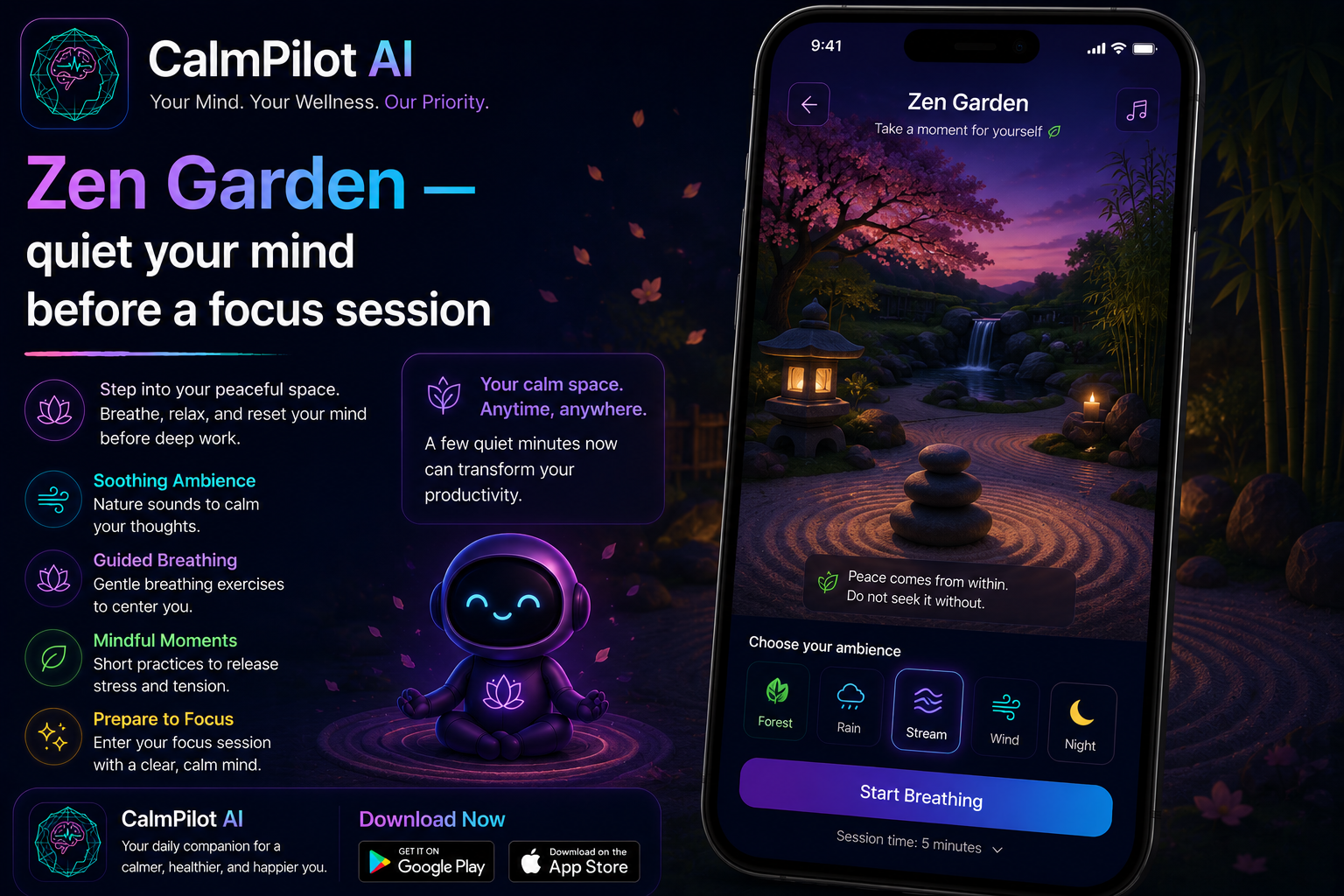
For many people, the real obstacle to sleep isn’t physical — it’s a mind that won’t stop reviewing the day or rehearsing tomorrow. This is called pre-sleep cognitive arousal, and it’s one of the most common drivers of sleep-onset insomnia.
Three techniques that reliably quiet a racing mind at bedtime:
- The worry dump: 10 minutes before bed, write every worry or task on paper. The act of externalising it signals to your brain that it doesn’t need to keep processing it.
- Tomorrow’s list: Write the three most important things you need to do tomorrow. Research shows this single habit significantly reduces bedtime rumination.
- Cognitive shuffle: Deliberately think of random, unconnected images — a red bicycle, a cloud, a potato. The randomness disrupts the narrative loops your brain runs at night.
8. Alcohol Disrupts Sleep — Even If It Helps You Fall Asleep
Alcohol is a sedative, not a sleep aid. It may help you fall asleep faster, but it dramatically reduces REM sleep (the restorative stage where emotional processing and memory consolidation happen) and causes fragmented sleep in the second half of the night.
Even two drinks within three hours of bed suppresses REM sleep by up to 24%. The sleep you get is lighter and less restorative — which is why you can sleep 8 hours after drinking and still wake up exhausted.
If you drink socially, finishing at least 3 hours before bed minimises the impact on your sleep architecture.
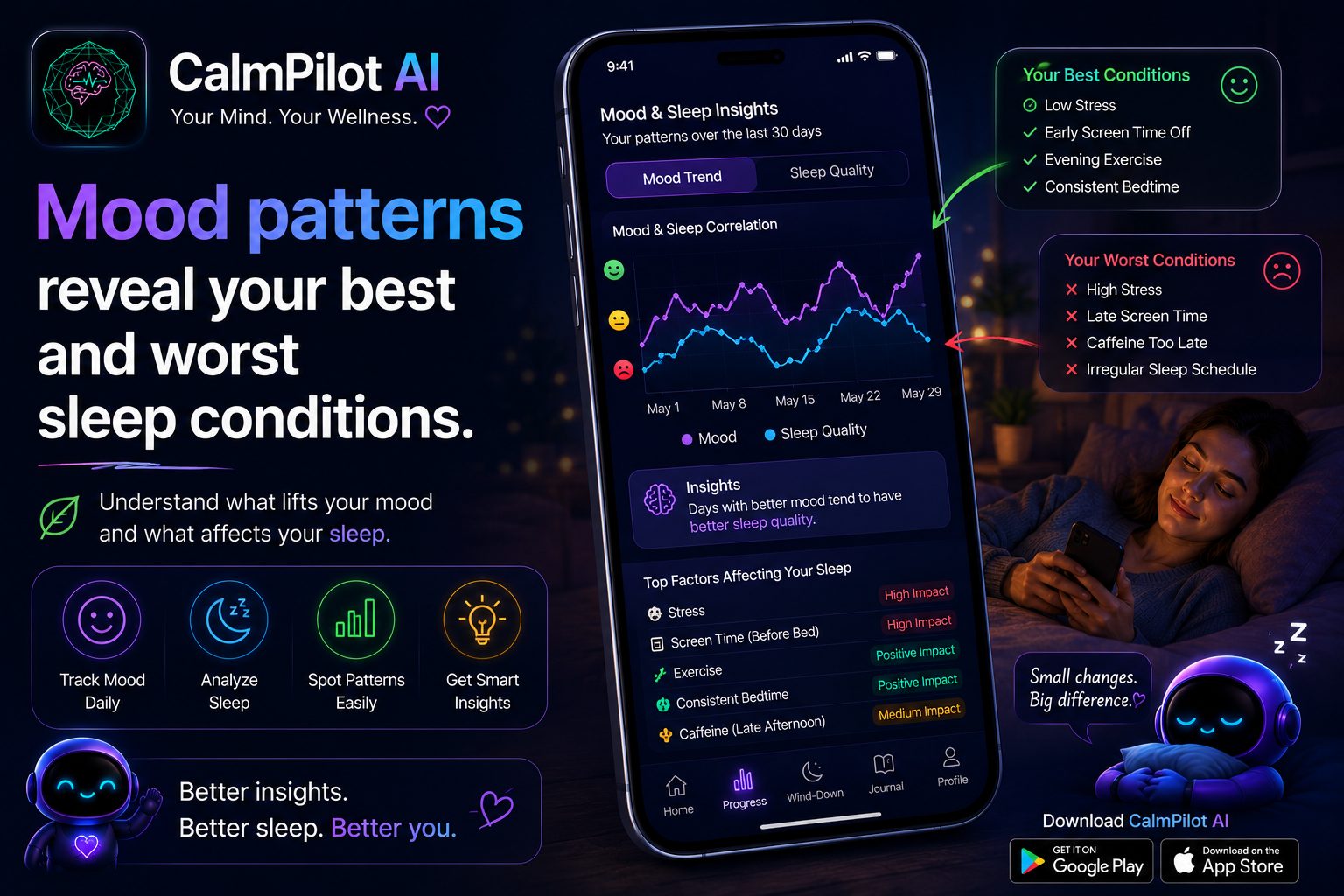
9. Track Your Mood to Find Your Sleep Patterns
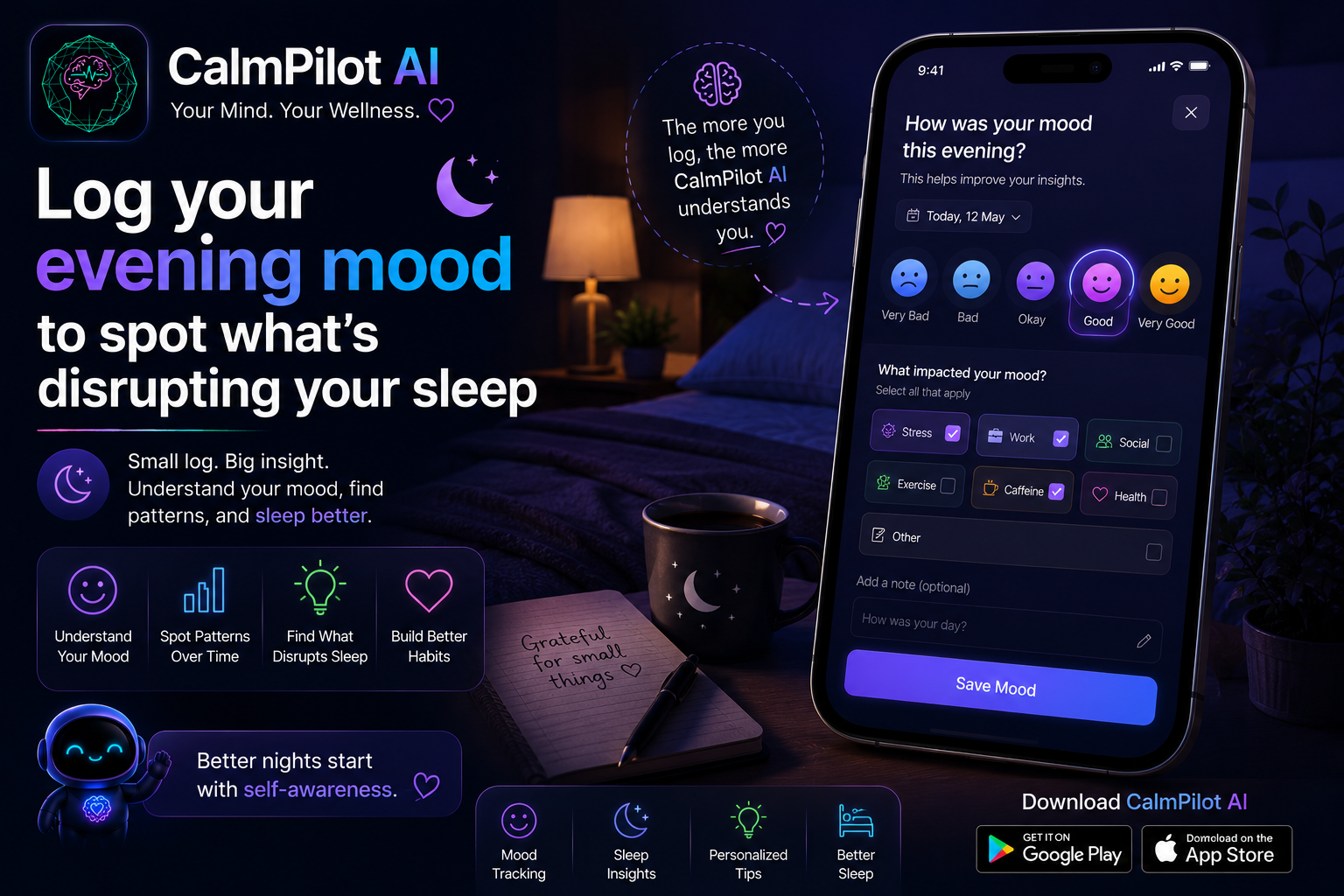
Sleep doesn’t exist in isolation — it’s intimately connected to your emotional state, stress levels, and what happened during your day. The days you sleep worst are rarely random. They follow patterns: high-stress days, late-night screen use, skipped movement, anxious evenings.
A daily mood check-in — even a brief one — makes those patterns visible. When you can see that your worst sleep consistently follows high-anxiety afternoons or late caffeine, you have something actionable to change. CalmPilot’s mood tracker and insight summaries are built exactly for this: connecting the dots between how you feel and how you sleep, so you can address the root cause rather than the symptom.
Start With One
You don’t need to implement all nine tonight. Pick the one that matches your biggest obstacle — if you lie awake with a racing mind, start with the worry dump. If you never feel tired at bedtime, fix your wake time first. If your room is warm and bright, start with light and temperature.
Sleep is one of the most underrated levers for mental health. Fix your sleep and almost everything else — mood, focus, resilience, patience — gets easier. It’s not a luxury. It’s the foundation.