

Somewhere between the cold plunge, the 45-minute journaling session, the green juice, the meditation cushion, and the gratitude list, the wellness industry quietly swapped the point. The goal was never a long morning. The goal was a good day. And the research on habit formation, behavioural psychology, and neuroplasticity is increasingly clear: a five-minute ritual performed every day does more for your mental health than an elaborate hour-long routine performed occasionally.
This is not an argument for laziness. It is an argument for understanding how human behaviour actually works — and building your morning around that understanding instead of against it.
The Problem with the Hour-Long Wellness Routine
Ask anyone who has designed an ambitious morning routine and you will hear the same story. It works brilliantly for three or four days. Then one morning runs late, or a child gets sick, or work starts early — and the whole routine collapses. What follows is not a graceful reduction to the essentials. It is nothing. The all-or-nothing mentality that complex routines require means that any breach tends to produce complete abandonment.
This is not a character flaw. It is predictable psychology.
Behavioural scientists call it the abstinence violation effect: once a rule is broken, people tend to abandon the entire effort rather than continue in a reduced form. The more elaborate the routine, the more rules there are to break, and the more opportunities for complete collapse. An hour-long morning programme is one late alarm away from not happening at all.
The best morning routine is not the most comprehensive one. It is the one you can actually do on your worst morning of the month — and still call a success.
What Behavioural Science Says About Small Habits
Stanford behavioural scientist BJ Fogg spent over two decades studying how people change behaviour. His central finding, published in Tiny Habits, runs counter to most self-improvement advice: motivation is not the engine of lasting behaviour change — ease is. The smaller and simpler a behaviour, the lower its activation energy, and the more reliably it gets done regardless of how motivated you feel on any given morning.
This maps precisely to what neuroplasticity research shows about habit formation. A behaviour becomes automatic through repetition — specifically, through the repeated activation of the same neural pathway. Every time you perform a habit, the myelin sheath around that neural pathway thickens, making the signal faster and the behaviour more effortless. But this process requires consistent repetition. A habit performed 300 times over a year builds a stronger neural pathway than a habit performed 50 times — even if those 50 sessions were each an hour long.
Five minutes every morning for a year is 365 activations. An hour-long routine done enthusiastically for two weeks and then abandoned is 14 activations. The five-minute ritual wins — not just in consistency, but in actual neurological change.
The Compounding Effect That No One Talks About
Small consistent rituals also produce a secondary effect that elaborate routines rarely do: they compound. Each morning you perform even a brief intentional practice, you reinforce your identity as someone who takes care of their mental health. This identity reinforcement — what James Clear calls casting a vote for the person you want to become — is the mechanism through which small habits produce large outcomes over time.
After 90 days of a five-minute ritual, you are not merely five minutes healthier each morning. You are operating from a self-concept that prioritises mental wellbeing. Decisions throughout the day — how you respond to stress, whether you take a walk, how you wind down at night — begin to align with that self-concept automatically, without effort or deliberation.
The hour-long routine, even when it works, rarely produces this identity shift — because it is framed as something you do when circumstances allow, not as a non-negotiable expression of who you are.
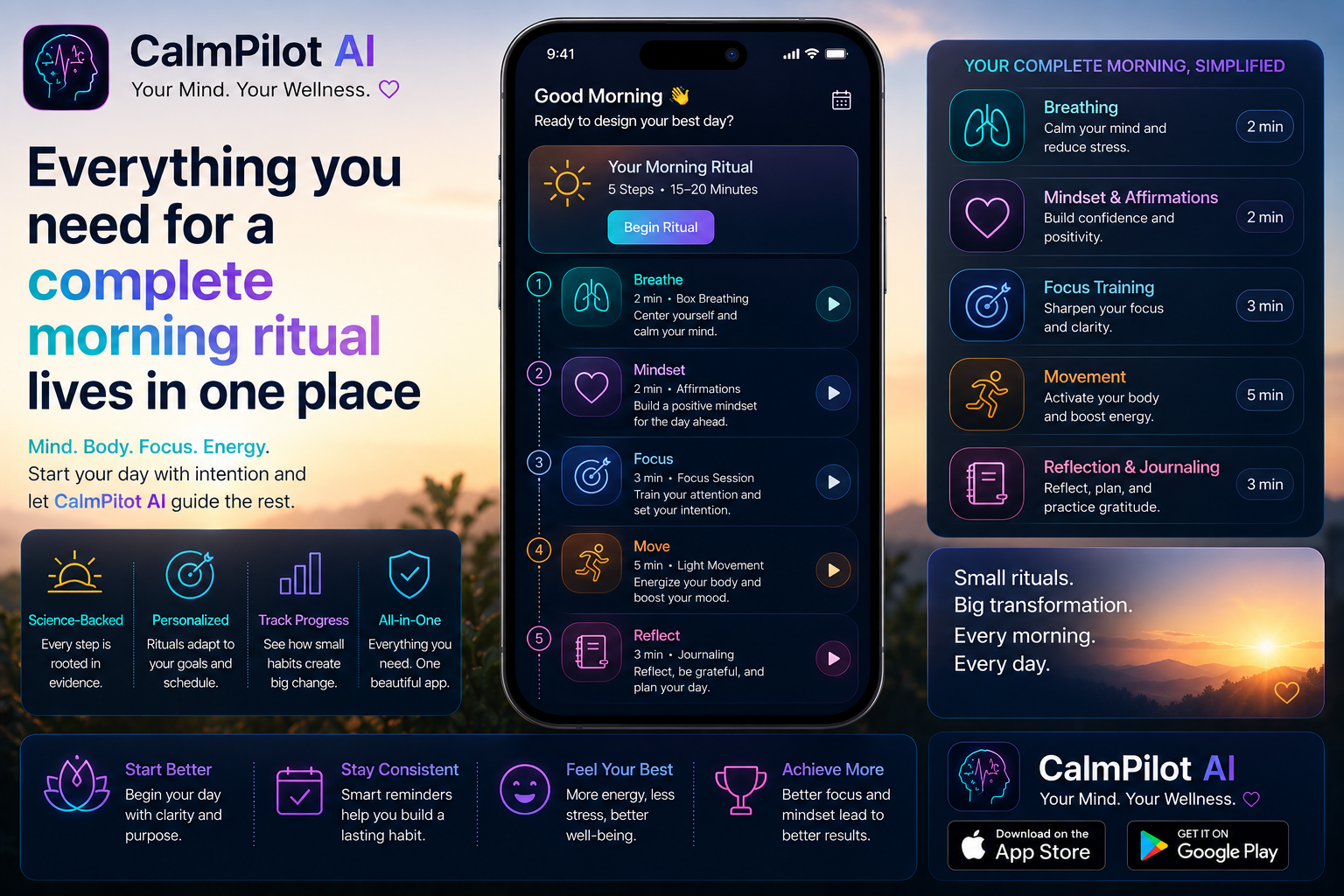
What Five Minutes Can Actually Accomplish
Five minutes is not a placeholder. Used deliberately, it is genuinely sufficient to shift your physiological and psychological starting state for the day. Here is what the research supports in that time window:
60 Seconds: Set Your Intention
Before looking at your phone, before checking email or news, take 60 seconds to answer one question: What do I want to feel like at the end of today? Not what you want to accomplish — what state you want to be in. Calm. Focused. Present. Energised. This brief act of intentional framing activates the prefrontal cortex and primes attentional systems toward the state you have named. Research on implementation intentions shows that naming a desired state or outcome significantly increases the probability of achieving it.
2 Minutes: Breathe With Purpose
Two minutes of slow, rhythmic breathing — ideally at a 5-seconds-in, 5-seconds-out pace — is enough to measurably shift your heart rate variability toward coherence and reduce baseline cortisol. This is not metaphorical. Studies measuring salivary cortisol before and after brief coherence breathing show statistically significant reductions within 90 seconds. Two minutes reliably delivers this effect. You do not need ten.
90 Seconds: Check In With Your Body
A brief body scan — starting at your feet and moving upward, noticing tension without trying to fix it — completes the physiological reset. This practice activates the interoceptive network, the system of brain regions that processes internal body signals. Consistent morning interoception has been linked to improved emotional regulation and reduced anxiety throughout the day, because you are training your brain to notice internal states before they escalate rather than after.
30 Seconds: Log Your Baseline State
Thirty seconds to note your mood and energy level — even a number from one to ten — provides data that, accumulated over weeks, reveals your patterns in ways that no single day can. On which days do you consistently start lower? After which evenings do you feel sharpest in the morning? This data is the foundation for making genuinely informed decisions about your lifestyle rather than acting on impressions and guesses.


Why Friction Is the Real Enemy of Wellness Routines
Every additional step in a morning routine adds friction. Friction is the enemy of consistency. Behavioural economists have measured friction effects in remarkable detail: organ donation opt-out vs opt-in systems differ by 40 percentage points in participation rates based solely on which is the default. Employees who have to actively enrol in retirement savings plans contribute at far lower rates than those who are enrolled by default and have to actively opt out.
The same friction dynamics apply to your morning routine. Every piece of equipment you need to locate, every app that requires loading, every decision about what to do next — each adds a small amount of resistance. Small amounts of resistance, accumulated across a complex routine, are enough to tip you into skipping the whole thing on mornings when your willpower is already depleted (which, by definition, includes most mornings following poor sleep, high-stress days, or disrupted schedules — exactly the mornings when you need the routine most).
A five-minute ritual designed with zero friction — same place, same sequence, same app open before you stand up — removes this failure mode almost entirely. The lower the activation energy, the more reliably the habit fires regardless of conditions.
The “Minimum Viable Ritual” Principle
The most durable morning practices are built around what product designers call a minimum viable product — the smallest version of something that still delivers the core value. Applied to morning rituals: what is the minimum you could do that still meaningfully shifts your mental state?
For most people, this turns out to be some combination of intentional breathing, a brief body or mood check-in, and a single moment of focused intention. Everything else — journaling, reading, exercise, cold showers — is additive. Valuable when you have time and energy. Not load-bearing to the core benefit.
Build your ritual around the minimum viable core. On days when time and energy allow, extend it. On days when they do not, do only the core — and count it as a complete success. This reframe alone removes the all-or-nothing collapse that kills most ambitious morning routines.
How Long Before It Becomes Automatic?
A frequently cited statistic claims habits take 21 days to form. This number comes from a misreading of a 1960 plastic surgery recovery observation, not from behavioural research. The actual data, from a 2010 study by Phillippa Lally at University College London, found that simple behaviours became automatic in an average of 66 days — with a range from 18 to 254 days depending on complexity.
The practical implication: a five-minute ritual, being among the simplest possible behaviours, reaches automaticity toward the lower end of that range. An hour-long routine, being complex and high-effort, either takes far longer to automate or never does — because the high activation energy means it never fires consistently enough to build the neural pathway in the first place.
If you want a morning ritual that feels effortless by summer, start with five minutes now. If you start with an hour, you may still be forcing it by summer — or you may have stopped entirely.
Designing Your Own 5-Minute Morning Ritual
The specific content of your ritual matters less than its consistency and its low friction. That said, research supports a few structural principles:
- Anchor it to an existing behaviour. Habit stacking — attaching a new behaviour to one you already reliably perform — dramatically increases success rates. Immediately after you pour your first drink of the morning (coffee, water, tea) is a reliable anchor for most people.
- Do it before reactive mode begins. The moment you check your phone or open email, your attention is being directed by other people’s priorities. Your ritual should precede this, even if only by five minutes.
- Keep the sequence fixed. Decision fatigue applies even to tiny choices. Knowing exactly what step comes next removes a micro-friction that, over time, adds up. Same sequence, every morning, without variation.
- Make it pleasant, not punishing. Rituals built around enjoyment are more durable than rituals built around discipline. If your five minutes feels like a reward for waking up rather than a tax for starting the day, you will do it longer.
- Track it visibly. The Seinfeld chain method — marking a calendar each day you complete the habit — leverages loss aversion (the desire not to break the chain) to sustain behaviour through low-motivation periods. Digital streak tracking in an app serves the same function.
The Bottom Line
The wellness industry profits from complexity. Complexity sells products, fills courses, and generates content. But complexity is not what changes behaviour — consistency is, and consistency requires simplicity.
A five-minute morning ritual — breathe, intend, check in — performed every single morning for a year produces more lasting change than any elaborate routine performed intermittently. Not because it is more impressive, but because it actually happens. And a habit that actually happens 365 times produces neurological, psychological, and identity-level change that no aspirational routine can match from the page of a planner it never leaves.
Five minutes. Every morning. That is the whole strategy. The rest is optional.