
For most of the history of brain training, sceptics had a compelling argument: people got better at the games they played, but nothing transferred. Train on a memory puzzle, get better at the memory puzzle — and nothing else changes. The real-world cognitive benefits claimed by brain training companies were largely marketing, not science.
Then came the N-Back.
In 2008, cognitive scientists Susanne Jaeggi and Martin Buschkuehl published a study in the Proceedings of the National Academy of Sciences showing that training on the N-Back task produced improvements in fluid intelligence — the ability to reason and solve novel problems — that transferred to tasks the participants had never practised. For the first time, a cognitive training exercise had demonstrated genuine, measurable transfer beyond the training itself. The field hasn’t been the same since.
What Is the N-Back Task? The Concept Explained Clearly
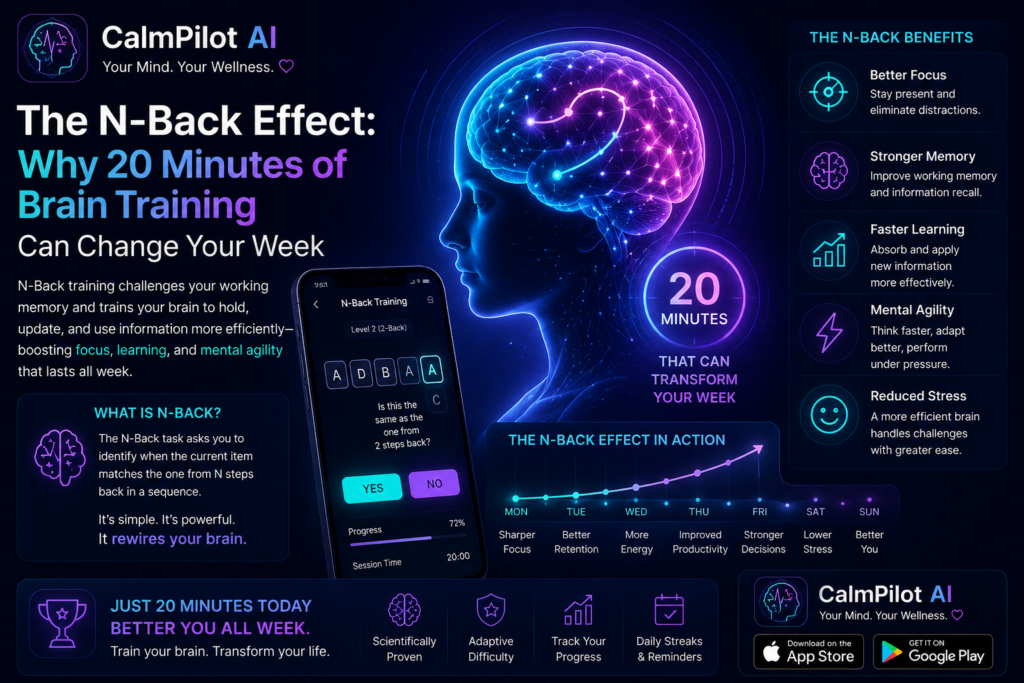
The N-Back task sounds deceptively simple. You are shown a sequence of stimuli — letters, positions on a grid, sounds — and your job is to identify when the current stimulus matches the one that appeared N steps back in the sequence.
In a 1-back task, you indicate when the current item matches the one immediately before it. In a 2-back task, you match against what appeared two items ago. In a 3-back task, three items ago. The dual N-Back — the most studied version — requires you to track two simultaneous streams at once: both the position and the identity of stimuli, matching each against the item N steps back.
What makes this hard is not the concept but the execution. As N increases, you must hold a longer sequence in active memory, continuously update it as new items arrive, and compare the current item against a target that keeps shifting. At 3-back and above, most people find it genuinely demanding — which is exactly the point. The difficulty is not a design flaw. It is the mechanism.
Why N-Back Training Improves Working Memory — The Neuroscience
Working memory — the brain’s active workspace for holding and manipulating information in real time — is the cognitive resource the N-Back task stresses most directly. Every increment of N demands that you maintain a longer sequence in active memory, continuously update it, and suppress interference from items that appeared slightly too early or too late to be the correct match.
This constant, demanding updating of held information is what differentiates N-Back from simpler memory games. Most memory tasks ask you to hold information static. N-Back requires continuous dynamic maintenance — which activates the dorsolateral prefrontal cortex and the parietal cortex more intensely and more consistently than passive recall tasks.
Neuroimaging studies show that N-Back training produces measurable changes in the activation patterns of these regions — and crucially, that the changes persist outside of training sessions. The brain has adapted: the circuitry responsible for working memory maintenance has been strengthened through consistent challenge, and that strengthening shows up in unrelated tasks that draw on the same circuits.
The N-Back works not because it tricks the brain with a clever game, but because it directly taxes the cognitive machinery that underlies broad mental performance — and taxes it hard enough, consistently enough, to force adaptation.
What Does N-Back Training Actually Improve in Daily Life?
The research since Jaeggi and Buschkuehl’s original study has refined and extended the findings. Here is what the evidence currently supports:
Working memory capacity — the most consistently documented effect. After 15–20 sessions of N-Back training, participants show measurable improvements in standard working memory tests that have no overlap with the N-Back task itself. This is the transfer effect: the training has strengthened an underlying capacity, not just performance on a specific exercise.
Fluid intelligence — Jaeggi’s original and most controversial finding. Fluid intelligence is the ability to reason about novel problems, identify abstract patterns, and think flexibly without relying on prior knowledge. It is considered the most “general” cognitive ability and the hardest to train. The N-Back evidence suggests it is not entirely immutable — though the magnitude of the effect and its durability remain subjects of ongoing research.
Sustained attention — N-Back training requires continuous, unbroken attention for the duration of each session. Participants who complete training programmes consistently show improvements on sustained attention measures, with benefits extending into tasks that require concentration over longer periods.
Interference control — the ability to suppress distracting or irrelevant information. This is the cognitive skill that lets you stay focused during a noisy meeting, ignore an irrelevant notification, or hold your current train of thought when interrupted. N-Back training directly exercises this ability through the suppression of lure stimuli — items that match N+1 or N-1 positions and must be correctly rejected.
Processing speed — faster N-Back performance over training sessions reflects improvements in how quickly the brain can update and query its working memory store, with some evidence of transfer to processing speed in unrelated tasks.
How 20 Minutes a Day Produces These Changes
One of the practically important findings from N-Back research is that the training dose required to produce meaningful effects is surprisingly modest. The original Jaeggi study used sessions of approximately 20–25 minutes. Subsequent studies have generally converged on a similar range: 15–25 minutes of active N-Back practice per session, across 15–20 sessions (three to four weeks of daily training).
This is a small time commitment relative to the cognitive changes documented. The key variables are not duration but intensity and consistency:
- Intensity — the task must remain genuinely challenging. If N-Back becomes easy, it stops producing adaptive stress. Well-designed implementations automatically increase N when performance improves, maintaining the difficulty at the threshold that drives adaptation.
- Consistency — daily or near-daily practice produces stronger effects than the same total hours distributed over a longer period. The brain adapts to challenges it encounters repeatedly and recently.
- Engagement — passive or distracted performance produces minimal benefit. The training effect depends on genuine effortful engagement with each trial.
Twenty minutes of fully engaged N-Back practice — approached as a genuine cognitive workout, not background activity — is a meaningful stimulus. Most people who maintain it for three to four weeks notice real differences in their daily focus, their ability to hold complex information in mind, and their tolerance for mentally demanding tasks.
The Controversy: What the Sceptics Say — and What It Means for You
It would be incomplete to discuss N-Back without acknowledging that the research is not uniformly positive. Several well-powered replication studies have failed to reproduce the fluid intelligence transfer effect. A 2013 meta-analysis questioned the durability of gains beyond the training period. And a major 2014 study by researchers at Georgia Tech found no significant transfer to fluid intelligence after dual N-Back training.
The honest picture is this: the working memory and sustained attention benefits of N-Back training are robust and well-replicated. The fluid intelligence transfer effect is real but more variable — it appears in some conditions, with some populations, under some protocols, and less reliably in others. The scientific debate concerns the magnitude and generalisability of the effect, not whether any effect exists.
For a person seeking practical cognitive improvement, this means: N-Back training reliably improves working memory and attention, and may improve broader cognitive performance. It is not a magic pill and will not dramatically raise your IQ. What it will do, practised consistently for three to four weeks, is produce a noticeable improvement in how your working memory feels and performs under daily cognitive load — the mental workspace that underpins almost everything you do that requires thinking.
Who Benefits Most from N-Back Brain Training?
The research suggests N-Back training produces the largest benefits in specific populations and contexts:
- People whose working memory is currently below their potential — through stress, poor sleep, or cognitive disuse. The training restores capacity that has been degraded, which often produces more dramatic subjective improvement than training someone already at their ceiling.
- Knowledge workers with high cognitive load — people whose daily work requires holding and manipulating large amounts of information benefit most from a stronger working memory buffer.
- People experiencing high stress or anxiety — chronic stress degrades the prefrontal cortex regions that N-Back training directly targets. Training these circuits while managing the stress that degrades them produces compounding benefit.
- Older adults — age-related working memory decline responds particularly well to N-Back training, with some of the most robust transfer effects documented in older adult populations.

How to Get the Most From N-Back Style Brain Training
If you want to apply N-Back principles effectively, the practical approach is straightforward:
- Start at a comfortable N level — typically 1-back or 2-back — and allow the difficulty to increase as your performance improves. Jumping to 3-back before you are ready produces frustration without additional training benefit.
- Train daily or near-daily — three to four sessions per week maintains some benefit, but daily training produces faster adaptation and stronger effects within the same time period.
- Give it your full attention — N-Back practised while half-distracted is not N-Back. The entire benefit depends on genuine cognitive engagement. Treat each session as a workout, not background activity.
- Commit to four weeks before judging the results — the first week typically produces little subjective improvement and significant frustration. The noticeable changes in daily cognitive performance tend to appear in weeks three and four, as the neural adaptations consolidate.
- Pair it with sleep and stress management — N-Back training strengthens the same prefrontal circuits that poor sleep and chronic stress degrade. The training compounds with good sleep; it fights upstream against poor sleep. Both matter.
Twenty Minutes That Actually Move the Needle
The brain training industry has produced a lot of noise and questionable science over the past two decades. The N-Back sits in a different category — not because it is perfect or universally transformative, but because the evidence for its working memory and attention benefits is robust enough to act on, and the time investment required is genuinely small.
Twenty minutes of engaged N-Back practice per day for four weeks is one of the most evidence-supported short investments you can make in your cognitive performance. The working memory improvements are real, the attention benefits transfer to daily tasks, and the adaptation compounds the longer you maintain the habit.
Your brain changes in response to what it is consistently asked to do. Ask it something hard, done well, done daily — and it responds.