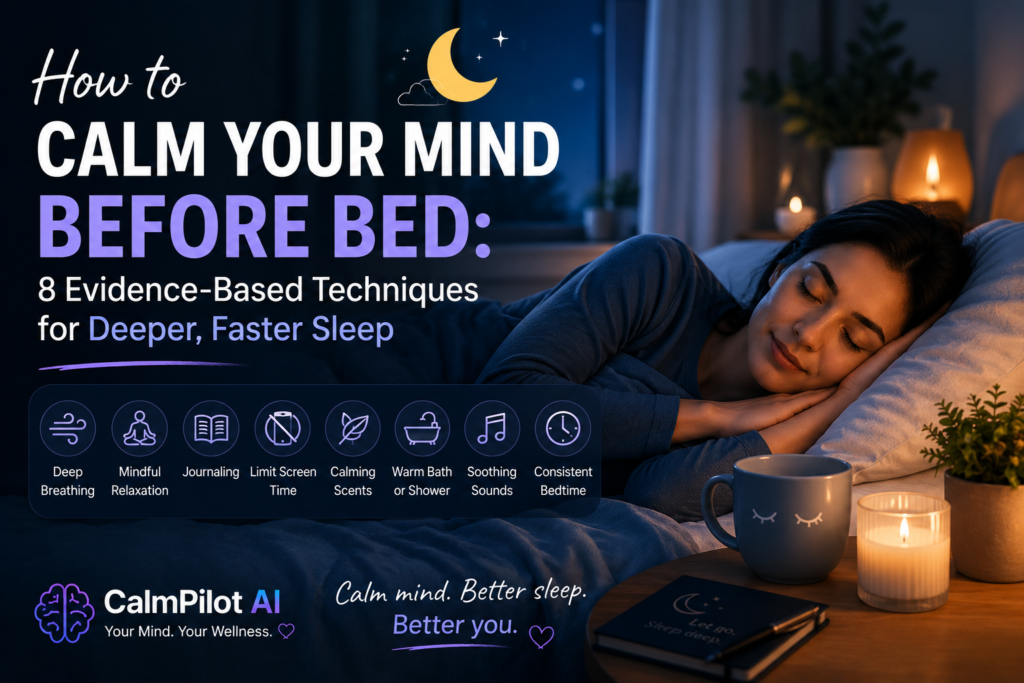
You’ve turned off the lights, put your phone down, closed your eyes — and your brain has decided this is the perfect moment to replay every awkward conversation from the past decade, draft tomorrow’s to-do list, and generate three new things to worry about. Sound familiar?
A racing mind at bedtime isn’t a willpower problem. It’s a neuroscience one. During the day, external demands keep your attention directed outward. The moment those demands disappear, your brain’s default mode network activates — and for many people, that network runs on anxiety, rumination, and unfinished mental business.
The good news: this is one of the most well-researched problems in sleep science, and there are specific, evidence-based techniques that work. Not relaxation advice — actual techniques with measurable effects on sleep onset and night-time anxiety.
1. The Cognitive Shuffle — Scramble the Story
Developed by sleep researcher Dr. Luc Beaulieu-Bonneau, the cognitive shuffle is one of the most effective techniques for stopping the narrative loops that keep you awake. It works by deliberately generating random, disconnected mental images — the kind of fragmented imagery your brain naturally produces as it drifts toward sleep.
When you force your brain into random-image mode, it can’t simultaneously run a coherent worry narrative. The two states are neurologically incompatible.
How to do it:
- Pick a random word — any word. For example: “market”
- Visualise the first thing it brings to mind as vividly as possible — an old market stall, a specific fruit, a stranger’s face
- After a few seconds, move to the next image — unrelated to the last
- Keep drifting between random images without connecting them into a story
Most people fall asleep before they’ve worked through 10 images. The deliberate randomness mimics the hypnagogic state — the natural imagery your brain produces at the threshold of sleep — which accelerates the transition.
2. Write It Down — Empty the Mental Inbox
Your brain is not a reliable storage system. When it’s holding onto unfinished tasks, unresolved worries, or things you’re afraid of forgetting, it stays alert — because at some biological level, it believes it needs to keep monitoring. Writing things down signals to the brain that the information is safe and no longer needs active holding.
A 2018 study published in the Journal of Experimental Psychology found that writing a to-do list for the next day — specifically listing tasks yet to be completed — significantly reduced bedtime cognitive arousal and helped participants fall asleep faster than those who wrote about completed tasks.
Keep a notepad by your bed. 5 minutes before you want to sleep, write:
- Every worry or concern that’s sitting in your mind
- The three most important things you need to do tomorrow
- Anything you’re afraid of forgetting
Once it’s written, your brain has permission to let it go. You don’t need to solve anything — just externalise it.
Writing your worries down isn’t procrastinating on them. It’s telling your nervous system it’s safe to stop guarding them for the night.
3. Box Breathing — Activate the Off Switch
Box breathing (also called square breathing) is used by Navy SEALs, surgeons, and athletes to rapidly reduce physiological arousal under pressure. It works by extending your exhale, which stimulates the vagus nerve and triggers the parasympathetic nervous system — your body’s rest-and-digest mode.
The technique:
- Inhale slowly through your nose for 4 counts
- Hold for 4 counts
- Exhale slowly through your mouth for 4 counts
- Hold for 4 counts
- Repeat 4–6 cycles
Within 2–3 minutes, most people notice a measurable drop in heart rate and a loosening of the physical tension that accompanies anxious thinking. It doesn’t require silence, a particular position, or any prior experience. It works in bed, in the dark, right now.
4. Progressive Muscle Relaxation — Release the Body First
Anxiety lives in the body as much as the mind. Tight jaw, raised shoulders, clenched hands — physical tension creates a feedback loop with anxious thinking, each one reinforcing the other. Progressive muscle relaxation (PMR) breaks that loop from the body end.
Starting at your feet and moving upward, tense each muscle group firmly for 5 seconds, then release completely for 20 seconds. Pay attention to the contrast — the warmth and heaviness in the released muscle. Move through calves, thighs, stomach, hands, arms, shoulders, neck, and face.
A full PMR session takes 10–15 minutes and produces a level of physical relaxation that’s difficult to achieve any other way. A shortened version — just hands, shoulders, and face — takes under 3 minutes and is enough to take the edge off on difficult nights.
5. The 5-Minute Brain Dump — Before You Get Into Bed
There’s a crucial timing element most people miss: the best time to process your day is not while you’re trying to fall asleep. It’s 20–30 minutes before bed, while you still have cognitive capacity to actually close things off.
Set a 5-minute timer and write, speak, or simply think through the day’s unresolved emotional content:
- What happened that still feels unfinished?
- What am I carrying into tomorrow that I’d rather put down tonight?
- Is there anything I’m avoiding thinking about that keeps surfacing?
You’re not trying to solve anything — you’re acknowledging it. The distinction matters. Acknowledgement closes the loop; problem-solving reopens it.
6. Lower the Room Temperature — Your Body Needs to Cool Down
Sleep onset requires a drop in core body temperature of approximately 1–2°C. This is a physiological requirement, not a preference. When your room is too warm, your body can’t achieve this drop efficiently, and sleep onset is delayed — which gives an anxious mind more time to run.
The optimal bedroom temperature for sleep is 17–19°C (62–67°F). If you can’t control your room temperature, a warm shower or bath 60–90 minutes before bed creates a paradoxical cooling effect: the dilation of blood vessels during a warm bath accelerates heat loss from the skin afterwards, producing a sharper core temperature drop that promotes faster sleep onset.
7. Talk It Through — Externalise What’s Looping
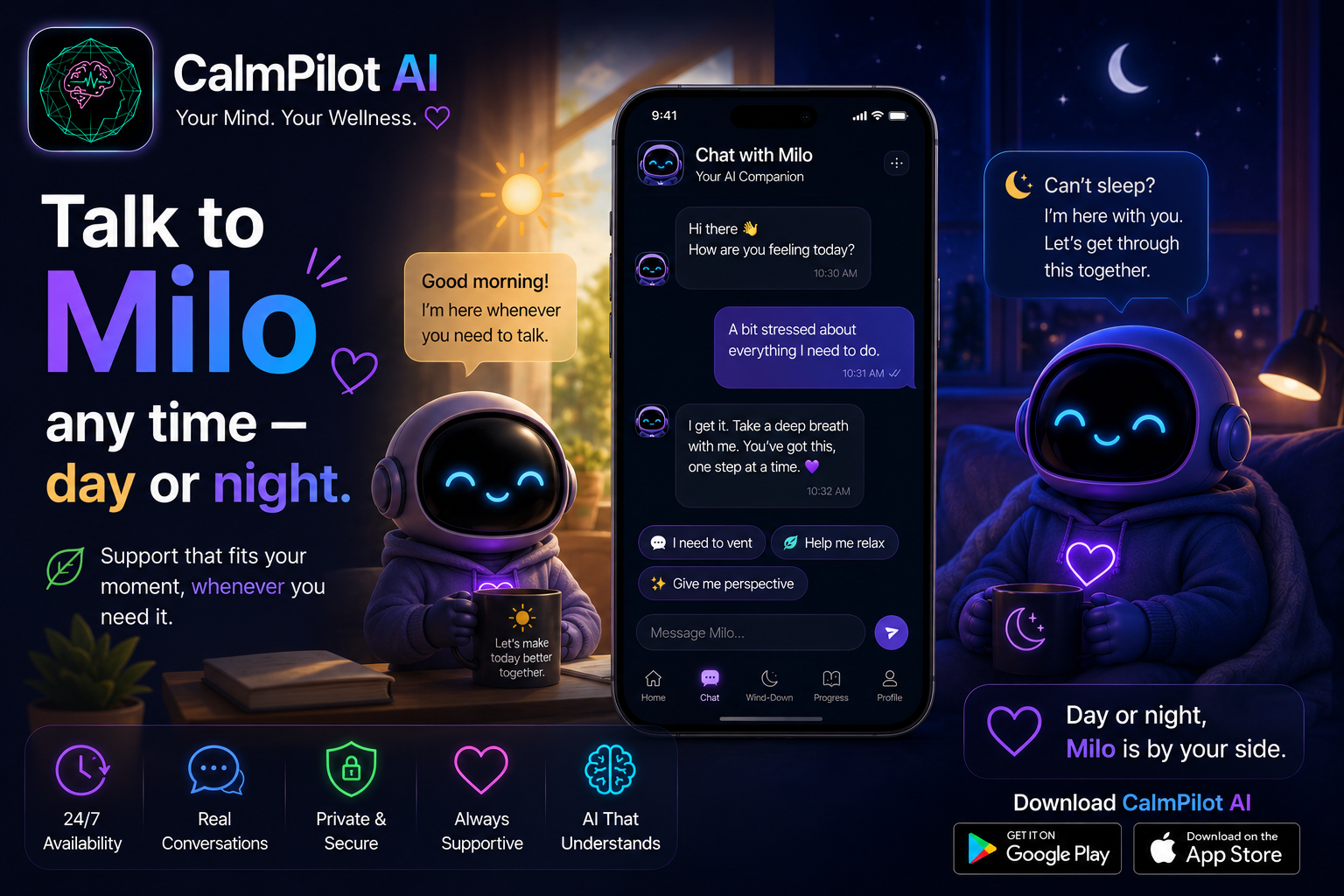
Sometimes the problem isn’t that you don’t know what you’re worried about — it’s that the worry is stuck in your head with nowhere to go. Speaking it out loud, to another person or to an AI companion, changes the dynamic. Externalising a thought forces you to articulate it more precisely, which often deflates its intensity.
Research on expressive disclosure shows that putting difficult thoughts into words — even briefly — reduces their emotional charge and decreases physiological arousal. The act of articulation moves the experience from raw, unprocessed feeling into structured language, which the brain processes differently and more calmly.
Milo, CalmPilot’s AI companion, is available at midnight for exactly this: somewhere quiet and non-judgmental to put the thoughts that are keeping you awake. Not to fix them. Just to say them out loud so your brain doesn’t have to keep holding them alone.
8. Use a Calming Game — Occupy Without Stimulating
Here’s a counterintuitive approach that works well for people whose minds don’t respond to stillness: a low-stimulation, visually calm game can quiet a racing mind more effectively than trying to force sleep directly.
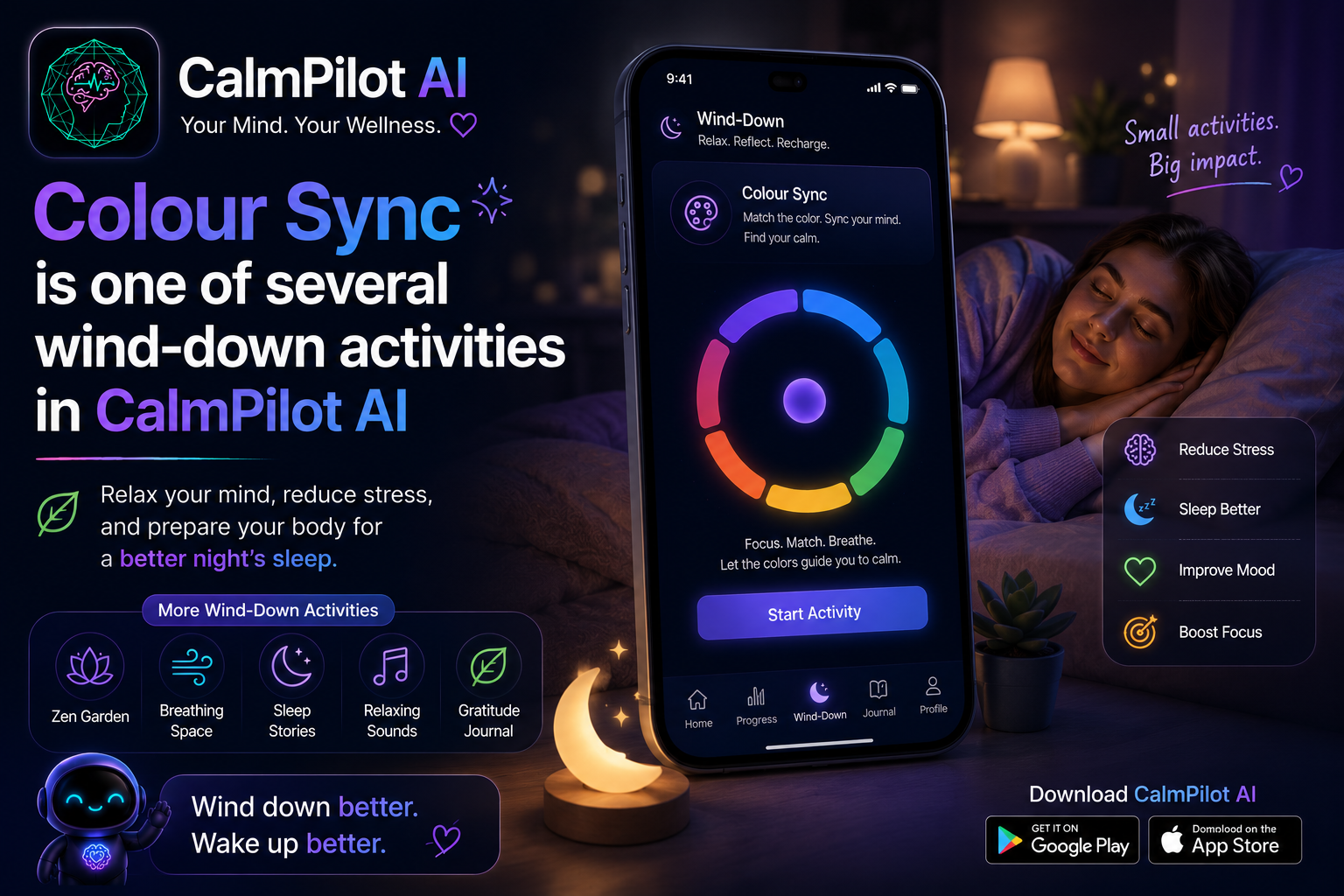
The mechanism is the same as the cognitive shuffle — a gentle task occupies the brain’s pattern-seeking system with something benign, preventing it from running anxious narratives. The key is choosing something calm, repetitive, and non-competitive. Colour matching, zen garden activities, and pattern games provide just enough cognitive engagement to prevent rumination without raising arousal.
This is different from scrolling — social media and news generate emotional responses that raise cortisol. A calming game creates a state of focused quiet. For many people, 5–10 minutes of a genuinely calm game produces the mental stillness that 30 minutes of trying to “just relax” couldn’t achieve.
Which One Should You Try Tonight?
If your mind races with specific worries — write them down before bed.
If your body is tense — progressive muscle relaxation.
If you’re stuck in narrative loops — cognitive shuffle.
If you need to feel physiologically calmer — box breathing.
If you just need somewhere to put it all — talk to Milo.
You don’t need to implement everything. Pick one technique, use it consistently for a week, and notice the difference. Sleep is a skill — and like any skill, it improves with the right practice, not more effort.
The goal tonight isn’t perfect sleep. It’s giving your mind one less reason to stay awake.