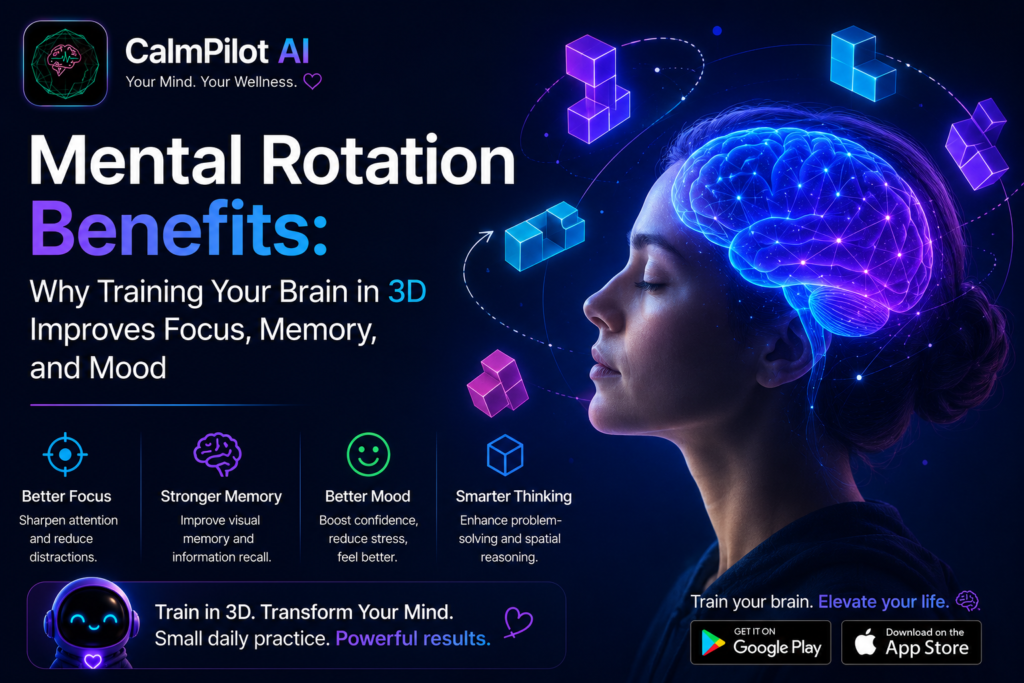
Close your eyes and picture a coffee mug. Now rotate it 90 degrees in your mind so the handle faces away from you. That mental act — holding a three-dimensional object in your imagination and moving it — is called mental rotation. It sounds like a party trick, but it’s one of the most researched and consequential cognitive skills in neuroscience.
Mental rotation underpins how you read maps, follow instructions, solve problems, and even regulate emotion. And unlike many cognitive abilities, it responds remarkably well to training — meaning deliberate practice actually makes it stronger. Here’s what the science says about why that matters.
What Is Mental Rotation — and Why Does It Matter?
Mental rotation is the cognitive ability to visualise and mentally transform two- or three-dimensional objects. First studied by Roger Shepard and Jacqueline Metzler in 1971, it was one of the first demonstrations that mental processes have measurable response times — your brain literally needs more time to rotate a shape 180° than 90°, just as a physical rotation would.
Beyond puzzles and spatial tasks, mental rotation is linked to:
- Mathematical ability — particularly geometry and problem-solving
- Working memory capacity — holding and manipulating information mentally
- Reading comprehension — understanding spatial descriptions and narratives
- Emotional regulation — cognitive flexibility and perspective-taking
- Creativity — recombining ideas and concepts in novel ways
Strengthening this one skill sends ripple effects across multiple areas of cognitive and emotional function.
1. Mental Rotation Training Improves Working Memory
Working memory is your brain’s mental workspace — the temporary storage where you hold and manipulate information while you use it. It’s what lets you follow multi-step directions, do mental arithmetic, or hold the beginning of a sentence in mind while you read the end.
Mental rotation exercises are among the most effective working memory training tasks because they demand that you actively maintain and transform a mental image — not just passively recall it. Research published in the journal Neuropsychologia found that regular spatial training, including mental rotation, produces measurable improvements in working memory capacity that transfer to unrelated cognitive tasks.
In practical terms: a stronger working memory means you lose your train of thought less often, juggle complex tasks more effectively, and make fewer errors under cognitive load.
Mental rotation isn’t just about visualising shapes. It’s a workout for the prefrontal cortex — the part of your brain responsible for planning, decision-making, and emotional regulation.
2. It Sharpens Focus and Sustained Attention
Mental rotation tasks require sustained, deliberate attention. You can’t complete them on autopilot — your brain has to actively engage and hold focus throughout. This makes them an effective training ground for the attentional networks that underlie concentration in everyday life.
Studies on children and adults show that regular spatial and rotation training improves performance on sustained attention tasks — not just on spatial tests themselves, but on unrelated focus measures. The attentional muscle gets stronger from the exercise regardless of the specific content.
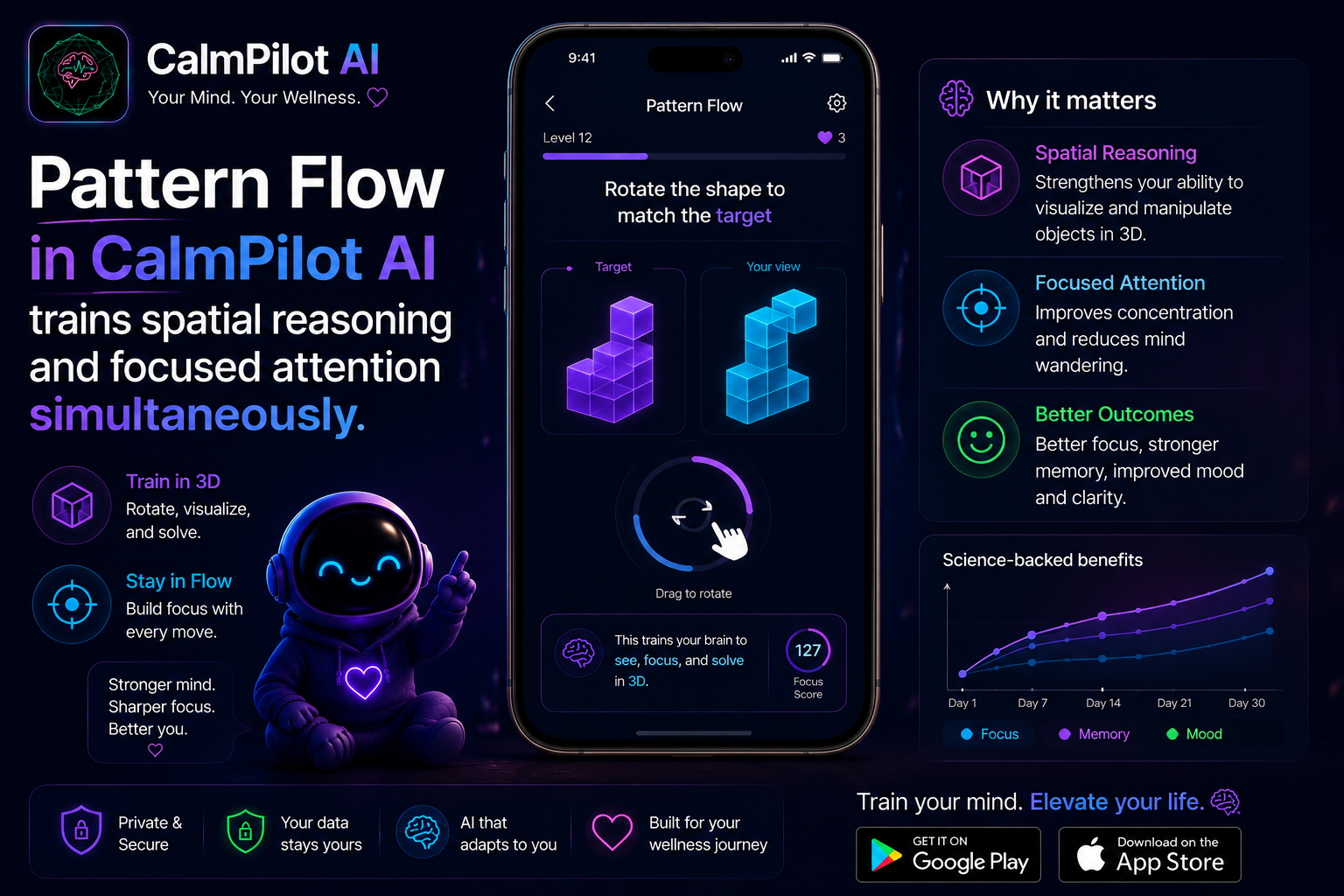
This is particularly relevant for people who struggle with focus and find traditional meditation or sit-still mindfulness practices difficult. A calming rotation-based game engages focused attention actively, making it a more accessible entry point for many people.
3. Spatial Training Reduces Anxiety and Cognitive Overload
This is the benefit most people don’t expect: mental rotation exercises have a measurable calming effect on an anxious mind. Here’s why it happens.
Anxiety is largely a function of the default mode network — the brain’s “resting state” network that, in anxious people, fills downtime with threat-scanning and worry loops. Engaging in a spatial task like mental rotation activates the dorsal attention network instead, which directly competes with and suppresses the default mode.
In other words: it’s very hard to ruminate while actively rotating a shape. The task occupies the cognitive bandwidth that worry needs to run. This is why puzzle and pattern games often feel genuinely calming — not just distracting, but neurologically incompatible with the anxiety loop.
This mechanism is similar to how other focused activities (flow states, craft, music) provide relief from anxious thinking — but spatial tasks are particularly effective because they engage visual-spatial processing areas that are anatomically distant from the emotional centres driving the worry.
4. It Builds Cognitive Flexibility and Problem-Solving
Cognitive flexibility is the ability to shift between different concepts, perspectives, or approaches — to see a problem from a new angle when the current angle isn’t working. It’s one of the executive functions most closely linked to creative thinking, adaptive behaviour, and emotional resilience.
Mental rotation is essentially a physical metaphor for cognitive flexibility made literal: you take something fixed and turn it around to see it differently. Regular practice builds the neural habit of perspective-shifting — which transfers into non-spatial contexts like interpersonal conflicts, stuck thinking patterns, and novel problem-solving.
People with higher spatial flexibility tend to generate more diverse solutions to problems, recover more quickly from setbacks, and show greater resilience in the face of uncertainty.
5. Regular Practice Strengthens Neuroplasticity
Neuroplasticity is your brain’s ability to change its structure and function in response to experience. It’s the mechanism behind all learning — and it remains active throughout life, though it becomes less automatic as we age.
Mental rotation training is one of the better-documented triggers of neuroplastic change in adults. Brain imaging studies show increased grey matter density in the parietal cortex (spatial processing) and prefrontal cortex (executive function) after sustained spatial training programmes. These are structural changes — not just performance improvements.
What this means practically: mental rotation isn’t just good for spatial skills. It’s a way of keeping your brain’s change machinery active and responsive, which slows cognitive ageing more broadly.
6. Mental Rotation Games Are Accessible to Everyone
One of the practical advantages of mental rotation as a brain training method is its low barrier to entry. Unlike many cognitive interventions that require specialised equipment, trained practitioners, or significant time commitment, spatial training can happen through brief, engaging game-based practice.
Research on game-based spatial training shows that even 10–15 minutes of daily practice with pattern and rotation games produces measurable improvements in spatial reasoning within 4–6 weeks. The key variables are consistency and progressive challenge — tasks that stay slightly ahead of your current ability, pushing the brain to adapt rather than coast.
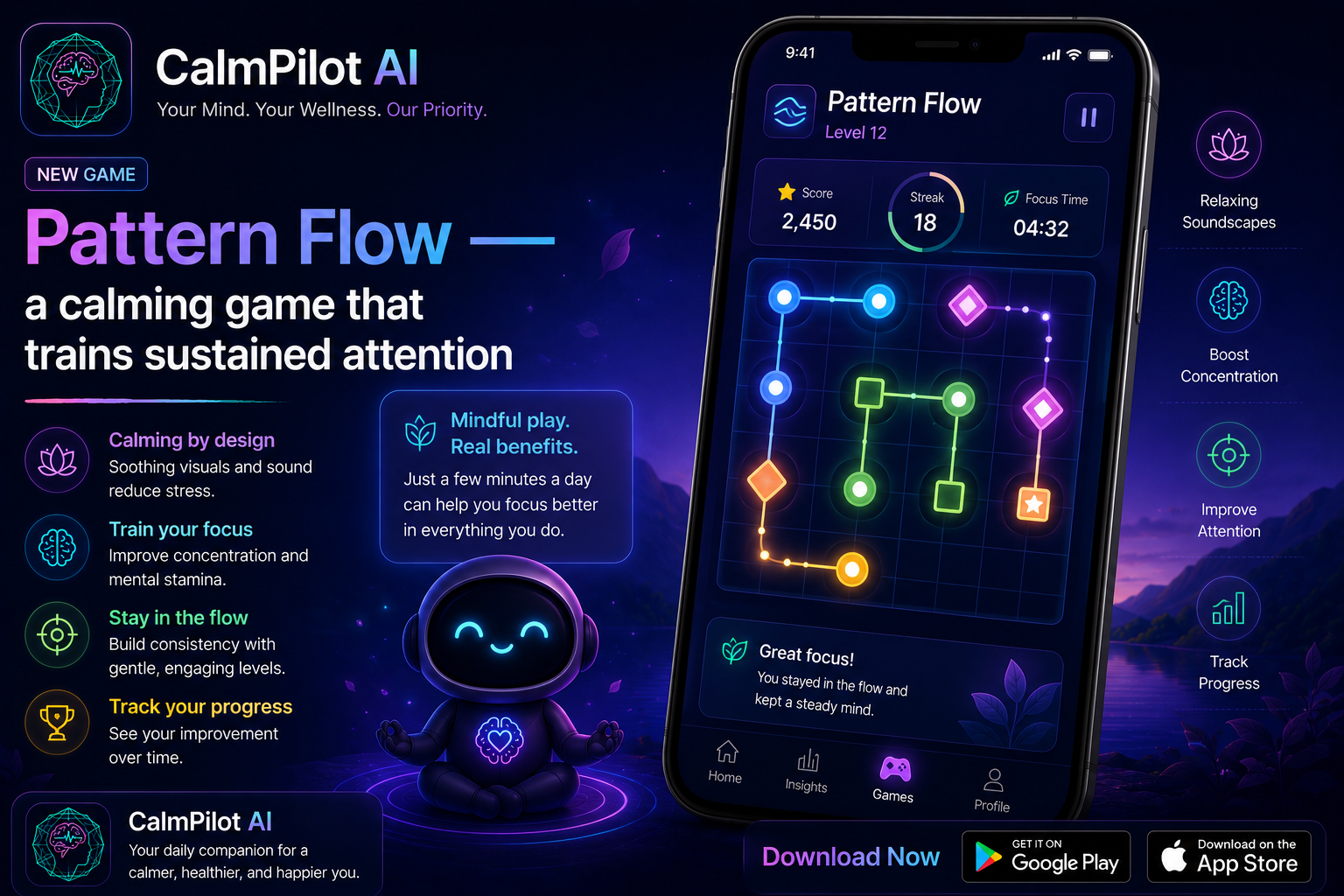
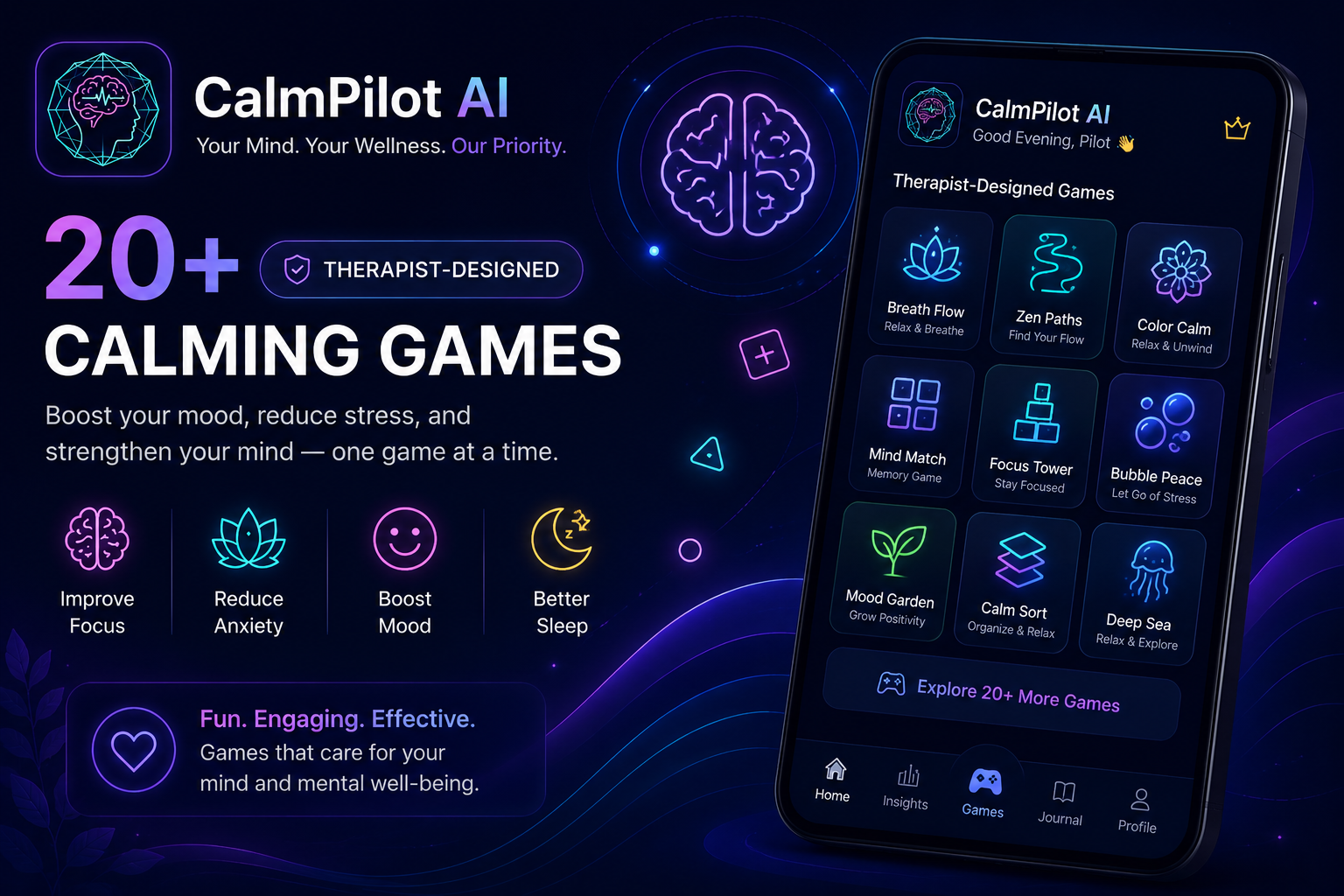
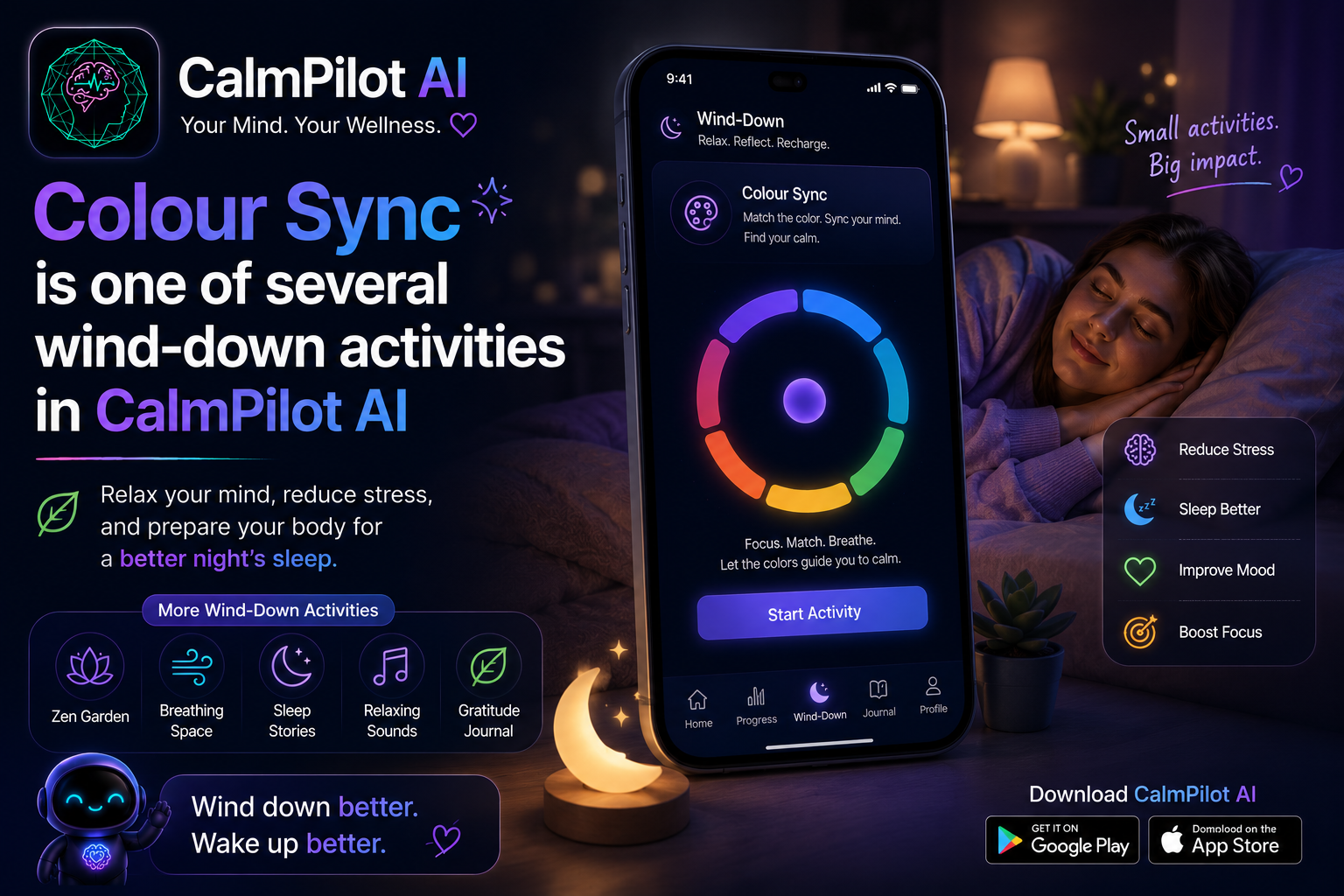
CalmPilot’s games — including Pattern Flow and Colour Sync — are designed with exactly this balance: calming enough to be accessible even on a difficult day, engaging enough to produce genuine cognitive training, and short enough to build into a daily habit without friction.
7. It Improves Mood Through Mastery and Flow
There’s a psychological benefit to spatial training that sits alongside the neurological one: the experience of mastery. Successfully completing a mental rotation task — solving the pattern, advancing to the next level — triggers a small but real dopamine release. This is the brain’s reward for accomplishment, however modest the task.
Regular exposure to small, achievable challenges builds what psychologists call self-efficacy — the belief that you are capable of meeting difficulty with competence. This is one of the most reliable protective factors against depression and anxiety.
At its best, a spatial game also induces a flow state — that absorbed, time-distorted quality of full engagement where self-consciousness drops and you’re simply in the task. Flow is one of the most reliably positive emotional experiences available to humans, and it’s one that spatial and pattern games are unusually well-suited to produce.
The Simplest Brain Workout You’re Not Doing
Mental rotation training doesn’t require a neuroscience lab or an expensive programme. Ten minutes a day of engaged, progressively challenging spatial practice — done consistently — is enough to produce real cognitive and emotional benefits over weeks and months.
The best version of this habit is one you actually do. That means it needs to be accessible, brief, and at least mildly enjoyable. A calming brain game that fits in a spare moment — on a commute, in a lunch break, as part of a wind-down routine — is more valuable than an intensive programme you abandon after a week.
Your brain is built to change. Give it something worth changing for.