
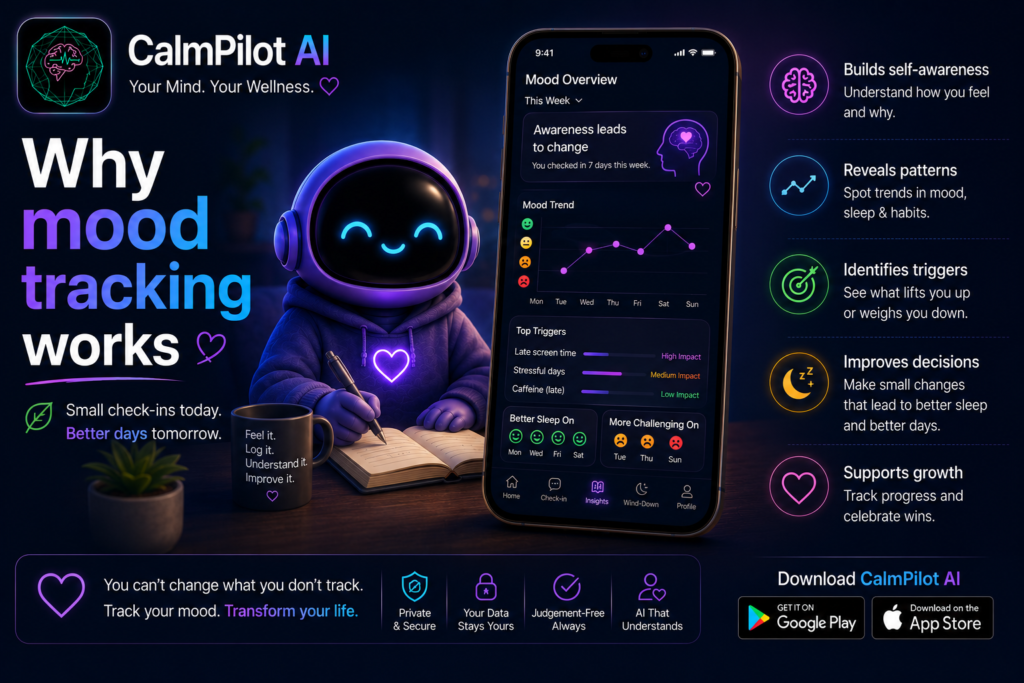
Ask most people why they had a bad week and they’ll say “I don’t know, I just felt off.” Ask them why last Tuesday was worse than Thursday and they’ll have no idea. We experience our emotions constantly — but we rarely examine them. And without examination, patterns stay invisible, triggers stay unrecognised, and the same bad weeks keep repeating.
Mood tracking changes that. Not because logging a number in an app is magic — but because the act of checking in with yourself, consistently, rewires how you relate to your own inner world. Here’s the science behind why it works.
1. You Can’t Manage What You Can’t Measure
This principle applies to business, health, and fitness — and it applies just as directly to emotional wellbeing. Most people operate on emotional autopilot, reacting to how they feel without ever stepping back to observe the pattern.
Mood tracking introduces a small but powerful pause between experience and reaction. Instead of just being anxious, you notice “I’m anxious — and I’m going to log that.” That pause is the beginning of emotional regulation. It shifts you from passive passenger to active observer of your own inner state.
Awareness is not the same as change — but no change happens without it. Mood tracking makes the invisible visible.
2. It Builds Emotional Granularity
Psychologist Lisa Feldman Barrett’s research shows that people who can distinguish between many different emotional states — not just “bad” but specifically “disappointed,” “ashamed,” “exhausted,” or “anxious” — handle stress and adversity significantly better than those who can’t.
This capacity is called emotional granularity, and it’s a trainable skill. When you track your mood daily, you’re forced to reach for specificity. Over weeks, your emotional vocabulary expands. You stop experiencing a blob of “feeling bad” and start identifying distinct states — each with different causes, different durations, and different solutions.
Higher emotional granularity is linked to lower rates of anxiety, depression, and aggression — and better recovery from difficult events.
3. Patterns Emerge That You’d Never Notice Otherwise
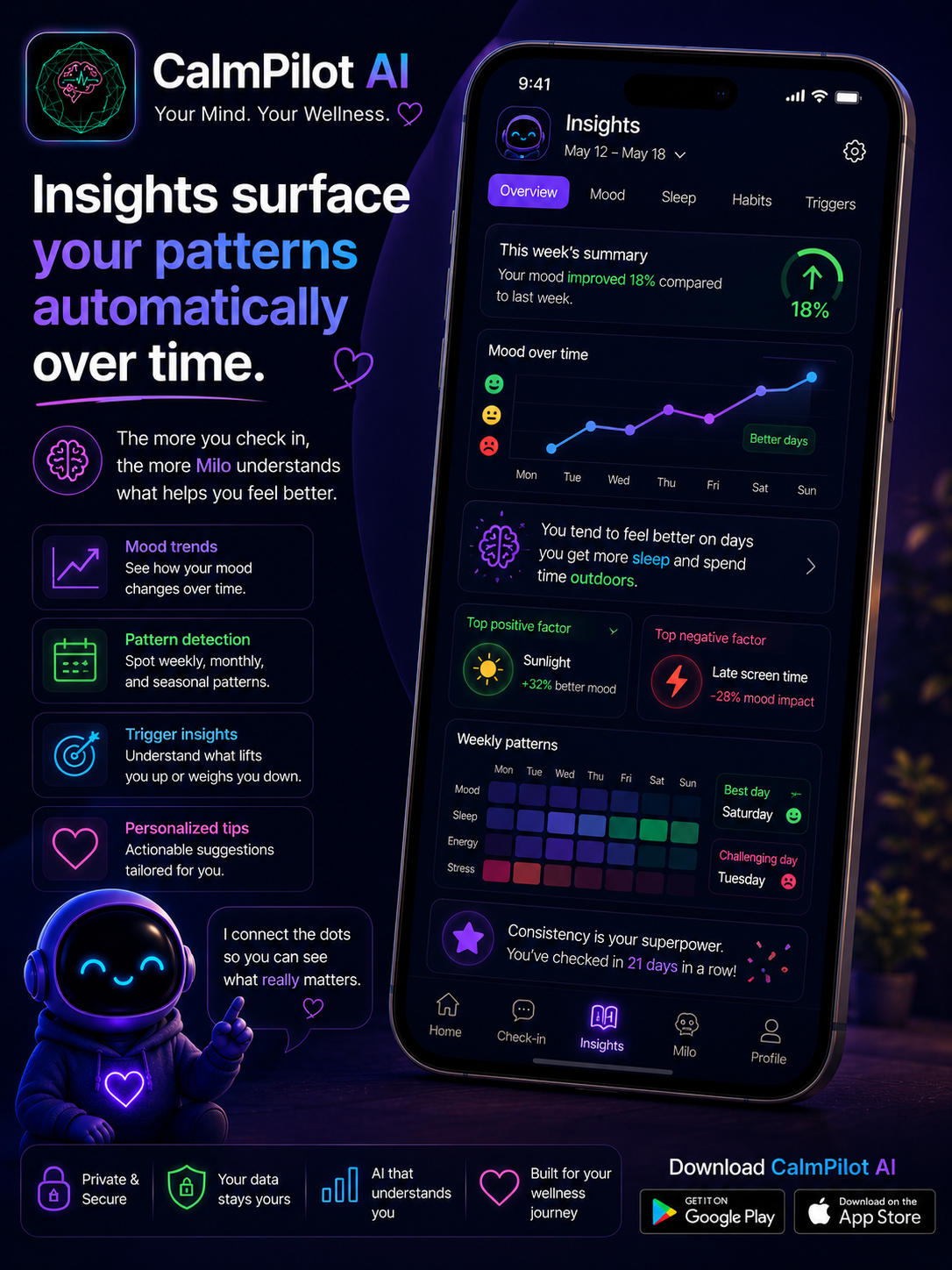
A single mood entry tells you very little. But 30 days of entries reveal something remarkable: your emotional life has a structure. There are triggers you didn’t know you had. Times of day or week when you’re consistently more vulnerable. Activities that reliably lift your mood. Situations that reliably tank it.
Common patterns people discover through consistent tracking:
- Mood drops sharply every Sunday evening (anticipatory anxiety about the week)
- Energy and mood are noticeably higher on days with morning movement
- Difficult interactions with specific people create a mood dip that lasts hours
- A particular type of work (creative vs administrative) affects afternoon mood differently
- Poor sleep the night before reliably amplifies negative emotional responses
These patterns are invisible in the moment. They only emerge in the data — which is why the tracking has to be consistent, not occasional.

4. It Interrupts Rumination Cycles
Rumination — replaying negative thoughts or experiences in a loop — is one of the most reliable predictors of depression and anxiety. The loop runs because the brain is trying to resolve something unfinished. But replaying doesn’t resolve. It just reinforces.
Logging a mood entry creates a small act of closure. You’ve acknowledged the feeling, given it a label, and recorded it. The brain’s pattern-completion drive gets a partial signal that the experience has been processed — which reduces the pull to keep running the loop.
It’s a similar mechanism to why writing worries down before bed reduces bedtime rumination. Externalising the thought signals to the brain that it no longer needs to hold it in active memory.
5. It Creates Accountability to Yourself
Most self-improvement efforts fail because there’s no feedback loop. You decide to eat better, sleep more, or stress less — but nothing tracks whether you’re actually doing it, and nothing reflects it back to you.
A mood tracker is a mirror. When you see your own data — a week of low scores following late nights, or a visible uptick after consecutive days of exercise — it’s harder to ignore than an abstract intention. The evidence is yours, collected by you, about you. That personal relevance makes it more motivating than generic advice.
Over time, the tracker becomes a gentle form of accountability: not to a goal or a standard, but to your own wellbeing.


6. It Reduces Emotional Reactivity Over Time
One of the most consistent findings in mood tracking research is that regular check-ins gradually reduce emotional reactivity — the tendency to be swept away by intense emotions before you can respond thoughtfully.
This happens for two reasons. First, the daily pause builds a habit of observation — you get used to noticing emotions rather than immediately acting on them. Second, seeing your own mood fluctuate over weeks builds perspective: the bad days become evidence that low moods pass, not proof that something is permanently wrong.
This shift — from “I feel terrible” to “I’m having a low mood day, and I’ve had these before and they passed” — is one of the core cognitive shifts that therapy works toward. Mood tracking builds it quietly, through repetition.
7. It Makes Therapy More Effective
If you see a therapist, a mood tracker is one of the most practical tools you can bring to that relationship. Instead of trying to recall how the past week felt from memory — which is notoriously unreliable and biased toward the most recent or most intense events — you arrive with actual data.
“I had three low days this week — Monday, Wednesday, and Friday — and looking at the notes, all three followed poor sleep” is a richer starting point than “I don’t know, the week felt hard.” It focuses the session on real patterns and real causes, rather than impressionistic summaries.
The Simplest Mental Health Habit You’re Not Doing
Mood tracking doesn’t require a journal, a strong memory, or a lot of time. A single daily question — how am I actually feeling right now, and what’s driving it? — is enough to start. Ten seconds, once a day, consistently.
The insight doesn’t come from any single entry. It comes from the accumulation — from weeks of small honest observations building into a picture of your inner life that you could never have assembled any other way.
Your emotional life has patterns. You just can’t see them yet.