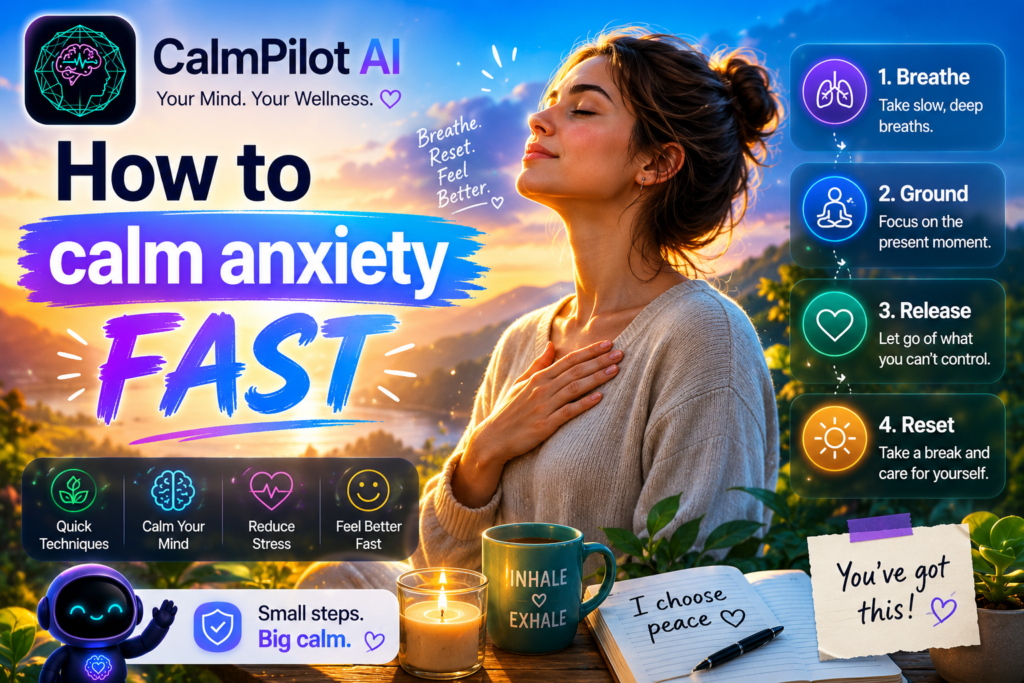
Anxiety doesn’t always knock politely. Sometimes it crashes in — tight chest, racing thoughts, the urge to run from everything and nothing at once. When that happens, the last thing you want is a ten-step programme. You need something that works right now.
The good news: your nervous system has a built-in off switch. These seven techniques activate it directly, and most take under three minutes.
1. The 4-7-8 Breath (Your Fastest Reset)
Developed from pranayama breathing practice, the 4-7-8 technique works by extending your exhale, which activates the parasympathetic nervous system — the part of your body responsible for calming down.
How to do it:
- Exhale completely through your mouth with a soft whoosh.
- Close your mouth and inhale quietly through your nose for 4 counts.
- Hold your breath for 7 counts.
- Exhale completely through your mouth for 8 counts.
- Repeat 3–4 cycles.
The extended exhale is the key. It lengthens the time your vagus nerve is stimulated, sending a direct “safe” signal to your brain.
2. Cold Water on the Face (The Dive Reflex)
This one sounds almost too simple — but it’s backed by biology. Splashing cold water on your face triggers the mammalian dive reflex, which slows your heart rate within 30 seconds.
The dive reflex is one of the strongest autonomic reflexes in mammals. Cold water on the face is enough to initiate it.
You don’t need ice water. Comfortably cold tap water works. Hold a damp cloth against your cheeks and forehead for 30 seconds if you’re somewhere you can’t splash.
3. The 5-4-3-2-1 Grounding Technique
Anxiety lives in the future (“what if”). Grounding pulls you back into the present by engaging your senses. This technique works anywhere — on a train, in a meeting, or in a quiet moment by yourself.
Name out loud or in your head:
- 5 things you can see
- 4 things you can physically touch (notice their texture)
- 3 things you can hear
- 2 things you can smell
- 1 thing you can taste
By the time you reach taste, the threat-response loop in your brain has usually quietened. Your sensory cortex and your amygdala compete for the same attention bandwidth — grounding wins.
4. Progressive Muscle Relaxation
When anxiety is mostly physical — tight shoulders, a clenched jaw, a headache building — trying to think your way out won’t work. Progressive muscle relaxation goes the other way: release the body first, and the mind follows.
Start at your feet and work upward. For each muscle group: tense hard for 5 seconds, then release completely for 20 seconds. Notice the warmth and heaviness as you let go. Move through calves, thighs, stomach, hands, arms, shoulders, and face.
A full cycle takes around 8 minutes. Even a shortened version — just hands, shoulders, and jaw — takes under 2 minutes and is enough to take the edge off mid-day.
5. Vigorous Movement (Even 90 Seconds)
Anxiety is your body preparing to run or fight — so give it something to do. Even brief intense movement burns off the cortisol and adrenaline keeping you wired.
- 30 jumping jacks
- Run up and down stairs twice
- 20 push-ups or squats
- A brisk walk around the block
You’re not trying to get fit — you’re completing the biological stress cycle your nervous system started. Movement is the signal that the threat is over.


6. Name It to Tame It
Neuroscience shows that labelling an emotion reduces activity in the amygdala (your brain’s alarm) and shifts control to the prefrontal cortex (your rational brain). Naming what you feel literally changes which part of your brain is running things.
Don’t just think “I’m anxious.” Get specific: “I’m feeling dread about the meeting because I’m afraid of being judged.” The more precise the label, the stronger the effect. This takes about 10 seconds and works entirely in your head.
7. Talk It Through with Milo
Sometimes anxiety isn’t just physical — it’s a spiral of thoughts that gets louder the quieter things get. Having somewhere to put those thoughts matters. Milo, CalmPilot’s AI companion, is available any time for exactly this: a calm, non-judgmental space to voice what’s going on.
Unlike searching your symptoms online (which almost always makes anxiety worse), Milo asks gentle questions, helps you identify patterns, and guides you toward techniques matched to what you’re actually feeling — not a generic checklist.
The Bottom Line
You don’t need to master all seven. Pick two or three that feel natural and practise them when you’re not anxious — so they’re wired in when you need them. The fastest way to calm anxiety in a moment is to have already practised the technique in a calm one.
Anxiety is not a character flaw. It’s your nervous system doing its job a little too enthusiastically. These techniques aren’t hacks — they’re direct lines to the part of your brain that already knows you’re safe.